
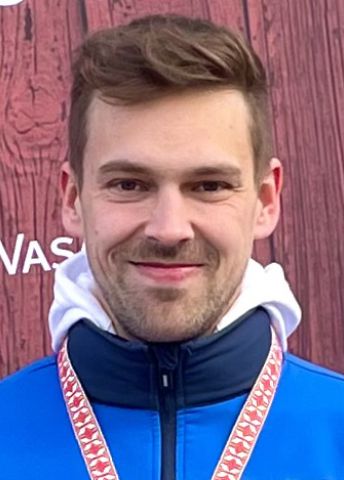
Program for mathematics 2026
Grant to a post-doctoral position abroad
Doctoral student Jorge Fariña-Asategui
Lund University
Postdoc at Université de Genève, Switzerland
Grant to a post-doctoral position abroad
Doctoral student Jorge Fariña-Asategui
Lund University
Postdoc at Université de Genève, Switzerland
Beyond classical group theory
Jorge Fariña-Asategui will receive his doctoral degree in mathematics from Lund University in 2026. Thanks to a grant from the Knut and Alice Wallenberg Foundation, he will hold a postdoctoral position with Professor Tatiana Smirnova-Nagnibeda at the University of Geneva, Switzerland.
In the early 1800s, group theory, which is overarching subject of the project, emerged from studies of symmetries in solutions to polynomial equations. These symmetries can be described using abstract objects called groups, and the understanding of Galois groups is vital for understanding solvability of the equations and the structure of polynomial roots. Later, group theory developed into a more abstract exploration of symmetries, which describes everything from the laws of physics to cryptography.
A classical question in group theory is whether it is possible to construct an infinite group using a finite number of finite symmetries. For the general problem, the answer is yes, and most examples are branch groups. These arise as symmetries of infinite trees, for example a binary tree that has pairs of branches: it consists of a node with two children, and then each child has two children, and so on.
Branch groups are fractal objects, as they contain smaller copies of themselves. Fractals occur everywhere in nature: from plants and crystals to the blood vessels and nerve cells in the body. The random behaviour of small particles in liquids or gases is also fractal. Such random walks and, more generally, dynamical systems – mathematical models of how a system evolves over time – now have a wide range of applications in mathematical physics, medicine, economics and biology.
The purpose of the research project is to provide a better description of the underlying structure of branch groups, particularly their fractal properties. Furthermore, the aim is to find links between branch groups, random walks and dynamical systems, which may lead the way to new applications of group theory in mathematics.
Photo: Joakim Cronvall