
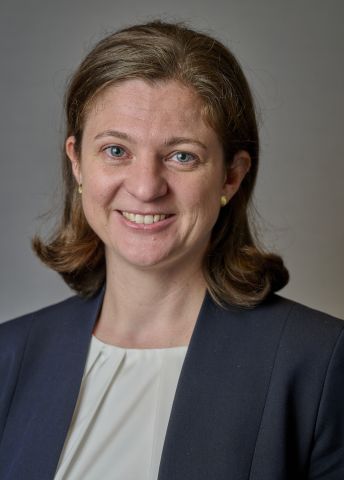
Wallenberg Academy Fellow 2025
Natural Sciences
Dr Elisabeth Gruber
University of Innsbruck, Austria
Nominated by Stockholm University
Natural Sciences
Dr Elisabeth Gruber
University of Innsbruck, Austria
Nominated by Stockholm University
Will recreate the interstellar chemistry in the laboratory
A rich and complex chemistry exists in the vast space between the stars – the interstellar medium. Wallenberg Academy Fellow Elisabeth Gruber will now mimic the extreme conditions of space to map cosmic chemistry. The goal is to understand which processes drive this chemistry, which molecules are formed, and to gain insights into the chemical pathways that shape the universe and the origins of life.
The interstellar medium is made up of roughly 99 percent gas and the rest is dust. Most of it is found in clouds or the nebulae that float between the stars. The gas is extremely cold and thin; it is made up of individual atoms and molecules which – when exposed to light and cosmic rays – can capture or lose electrons, transforming them into ions.
Atoms, molecules and ions interact with each other and form new molecules in the interstellar medium. Some are simple, such as hydrogen and carbon monoxide, while others become surprisingly complex and resemble the building blocks of life.
Dr Elisabeth Gruber at the University of Innsbruck, Austria, will now recreate space’s extreme chemistry in a laboratory setting. She will insert atoms and molecules in nanodroplets made from helium atoms with extraordinary properties. In these ultracold droplets, atoms, molecules and ions can combine into larger complexes. Elisabeth Gruber will develop new experimental methods to study these species to better understand the chemistry of the universe and how it may provide a foundation for emerging planetary life.
As a Wallenberg Academy Fellow, she will work at Stockholm University.
Photo: Patrik Lundin