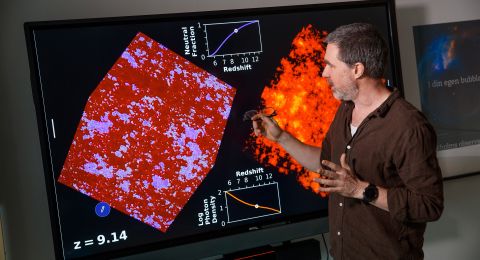
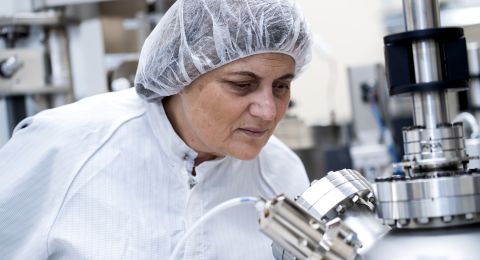
Temperatures in the thin gas and dust between the stars in the universe can be as low as minus 270 degrees Celsius. Yet new molecules can be created there. How is this possible? Henning Schmidt’s research team is attempting to understand fundamental processes behind the formation of new stars.
Project Grant 2024
“Making and breaking of molecular bonds”
Principal investigator:
Henning Schmidt, Professor of Atomic Physics
Co-investigators:
Stockholm University
Henrik Cederquist
Åsa Larson
Henning Zettergren
University of Gothenburg
Dag Hanstorp
Institution:
Stockholm University
Grant:
SEK 35 million over five years
Enormous gas clouds drift between the stars. This ”interstellar medium” is a dilute gas mixture of ions, atoms and molecules, along with dust grains, cosmic radiation and magnetic fields.
The atoms moving there are mostly hydrogen – but there are also small quantities of helium and carbon atoms – existing at temperatures as low as minus 270 degrees Celsius.
“The extremely low temperature inhibits chemical reactions, but the atoms present can still move slowly,” explains Schmidt, who is a professor of atomic physics at Stockholm University. He heads a research team studying how new matter is created in space.
“Despite the extreme cold, new molecules can form in the clouds, potentially leading to the birth of a new star.”
Such “star births” often occur in dark, denser parts of the gas clouds.
Cosmic radiation crucial
Schmidt and his team are seeking answers to the mystery of how matter can form in interstellar clouds. The project, funded by Knut and Alice Wallenberg Foundation, focuses on certain key phenomena.
Atoms and molecules floating in the gas dust are sometimes exposed to high-energy cosmic radiation emitted by the sun, stellar explosions and other active stars.
“The gas cloud itself is cold, and the molecules move slowly relative to each other. But there may be a nearby star emitting ultraviolet light, which in turn creates wandering ions.”
Cosmic radiation affects the atoms and molecules, causing positively charged ions to be formed and electrons to be simultaneously released. Those electrons can then bind to atoms or molecules and form negative ions.
Recreating space
The researchers believe the ions help to trigger chemical processes that create building blocks for new stars. Their experiments therefore aim to recreate events in space when a positive ion and a negative ion meet and a reaction occurs, which can both break molecular bonds and form new ones.
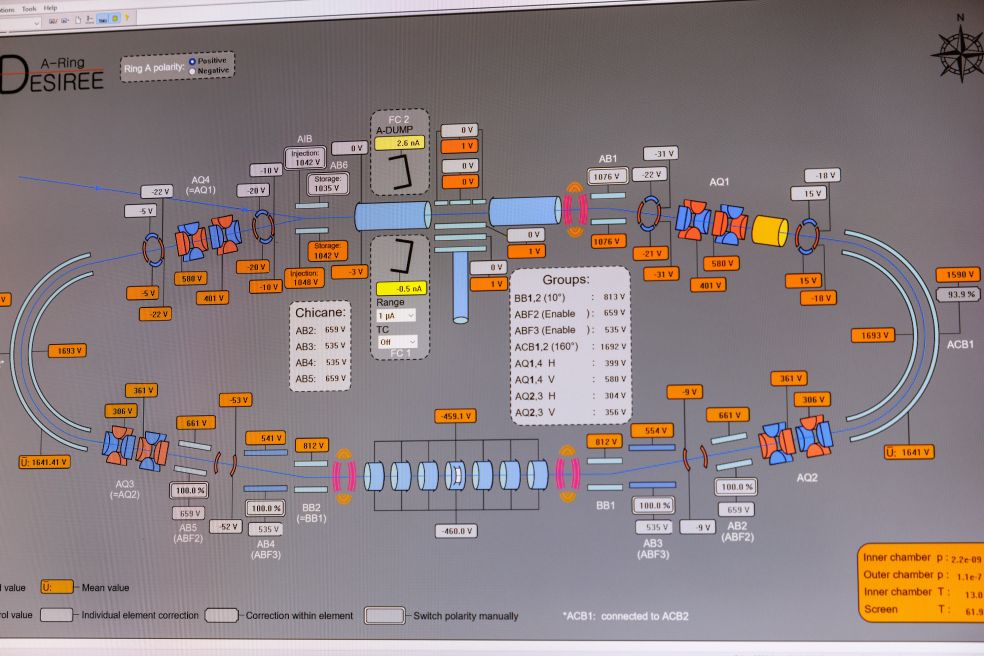
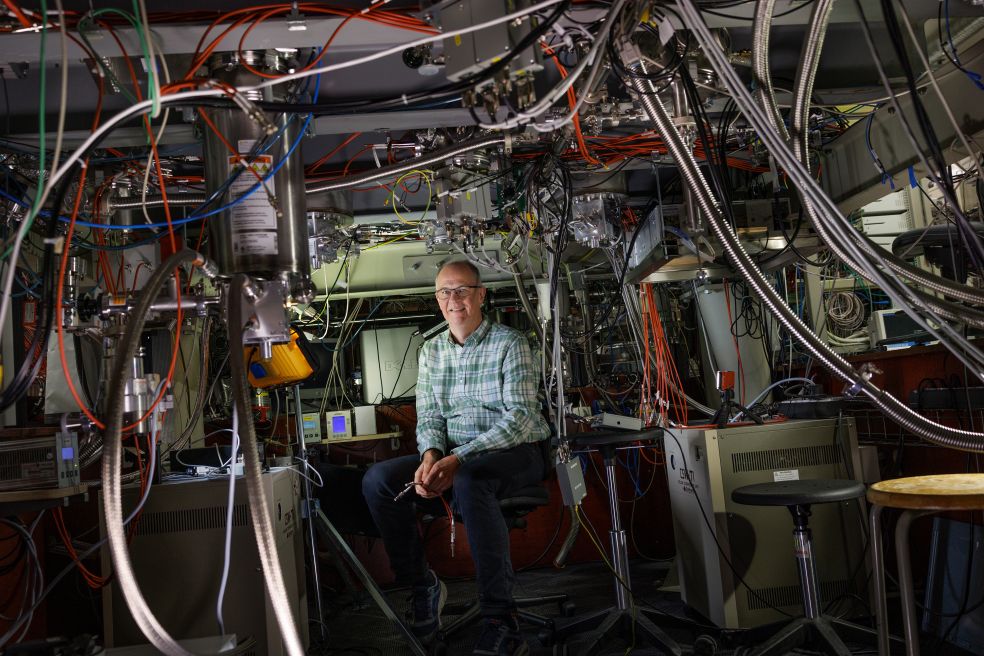
“Our basic hypothesis is that collisions between ions are of great importance for the growth of molecules and new stars in space,” says Schmidt – who is also director of the national atomic physics infrastructure facility DESIREE – Double ElectroStatic Ion Ring ExpEriment – located at the Department of Physics at Stockholm University in AlbaNova, where the group is conducting its world-unique experiments.
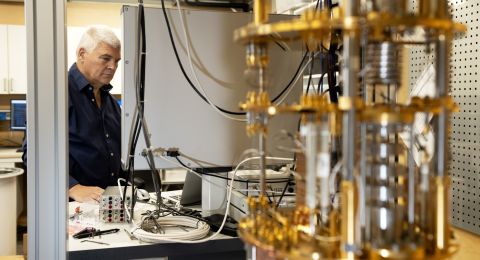
At the center of this facility stands a large rectangular box housing two storage rings. In one, several hundred thousand or up to a million positive ions circulate – and in the other ring about the same number of negative ions circulate, as part of the researchers’ experiments.
The ion beams meet where the rings overlap in a central section cooled to minus 260 degrees Celsius. Along this shared path, negative and positive ions travel together in a beam while moving slowly relative to each other.
“Sometimes a positive and a negative ion come close enough to one another for an electron to jump from the negative to the positive ion. What then occurs is a charge-transfer process, in which energy is released and new molecules can be formed,” says Schmidt.
The researchers’ use of ions instead of neutral particles enables them to overcome certain reaction barriers. Molecular bonds can then be broken and new bonds formed.
This charge-transfer process is central to the project. The researchers will now combine theory, modeling and, importantly, experimental work to produce detailed descriptions of how the reactions proceed.
Colliding particles simultaneously neutralize each other and lose their electric charge. They can therefore no longer continue to circulate in their ring in DESIREE. As neutral particles, they instead travel straight ahead through the central section and are captured by a detector.
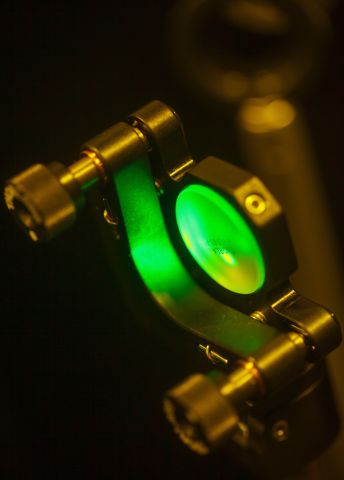
When the particles strike the detector, it emits small light signals that the researchers study.
When these are filmed, the light signals resemble flashing green dots racing forward. The detector measures the time between the dots and their positions, enabling the researchers to calculate their kinetic energy and quantum states.
Creating a new sensor
The researchers wish to monitor these events in detail. To do so, they are developing a new and extremely sensitive sensor called a microcalorimeter. This will enable them to measure the kinetic energy of the particles more precisely. The sensor is being developed in collaboration with a doctoral student at Ruprecht Karls University in Heidelberg, Germany, and is not expected to be ready until 2028.
But once the sensor is in place at DESIREE, the researchers will gain brand-new knowledge about the atomic mass of the particles, revealing the types of new molecules, or substances, that have formed.
However, Schmidt points out that the microcalorimeter must be cooled to minus 273 degrees Celsius, i.e., close to absolute zero, 0.02 Kelvin.
“Cooling something to such a low temperature will be quite a challenge.”
Text Monica Kleja
Translation Maxwell Arding
Photo Magnus Bergström