
Program for mathematics 2026
Grant to a post-doctoral position abroad
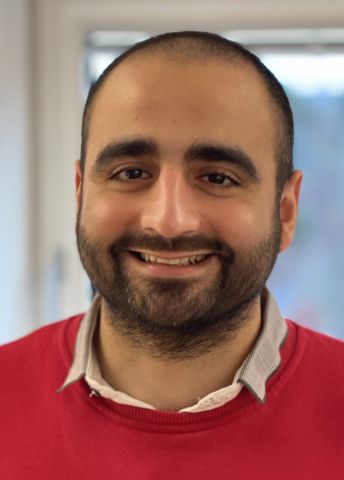
Doctoral student Alireza Ataei
Uppsala University
Postdoc at LMU Munich, Germany
Grant to a post-doctoral position abroad
Doctoral student Alireza Ataei
Uppsala University
Postdoc at LMU Munich, Germany
Exploring a unified theory for all matter
Alireza Ataei will receive his doctoral degree in mathematics from Uppsala University in 2026. Thanks to a grant from the Knut and Alice Wallenberg Foundation, he will hold a postdoctoral position with Professor Phan Thành Nam at the Ludwig Maximilian University of Munich (LMU Munich), Germany.
One of the central areas of research in mathematical physics is the study of the fundamental structure of matter. In particle physics, the smallest components of matter are divided into two main types: bosons and fermions. Fermions obey the exclusion principle, which prohibits two identical fermions from occupying the exact same state at the same time. This principle is the foundation for understanding everything from the structure of atoms to that of the periodic table. Bosons, on the other hand, can occupy the same state, which enables collective phenomena such as laser light and superconductivity.
Something entirely new occurs when particles are confined to move in only two dimensions, such as in extremely thin materials. Then particles can behave as so-called anyons, with properties intermediate between those of bosons and fermions. The anyons were first predicted theoretically in the 1970s and were given their name in the early 1980s by the American Nobel Prize laureate Frank Wilczek, who also showed that they may have entirely new properties. For a long time, anyons remained a purely a theoretical construct, but in the early 2020s, scientists succeeded in observing them directly in experiments for the first time. Despite this breakthrough, the collective behaviour of anyons remains one of the great unsolved mysteries of modern physics.
The aim of the project is to develop a uniform theory for elementary particles, in which bosons and fermions will be regarded as special cases within the broader framework of anyons. The project’s impact could reach far beyond mathematics, with significant consequences for both our understanding of quantum physics and for future applications, not least in the development of quantum computers.
Photo: unknown