The first stars in the universe are long gone. They lived short, intense lives and died out before any of the galaxies we know today had even begun to take shape. Wallenberg Academy Fellow Thomas Nordlander is studying the early universe by investigating the traces left behind by the first stars.
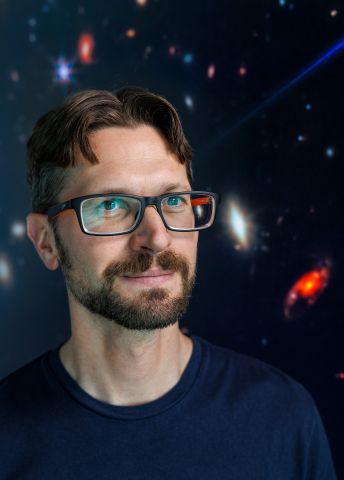
Thomas Nordlander
PhD in Astronomy
Wallenberg Academy Fellow 2023
Institution:
Uppsala University
Research field:
The early evolution of the Milky Way and the properties of the first stars.
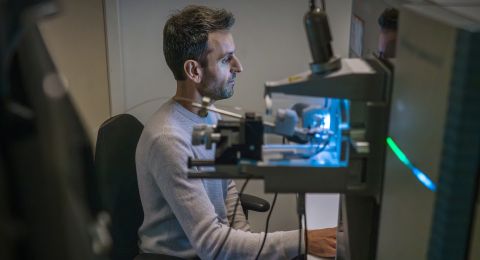
Nordlander is conducting a kind of cosmic archaeology at the Ångström Laboratory at Uppsala University. He is searching for traces of the early universe by mapping extremely old stars that bear a chemical legacy from the first generation of stars.
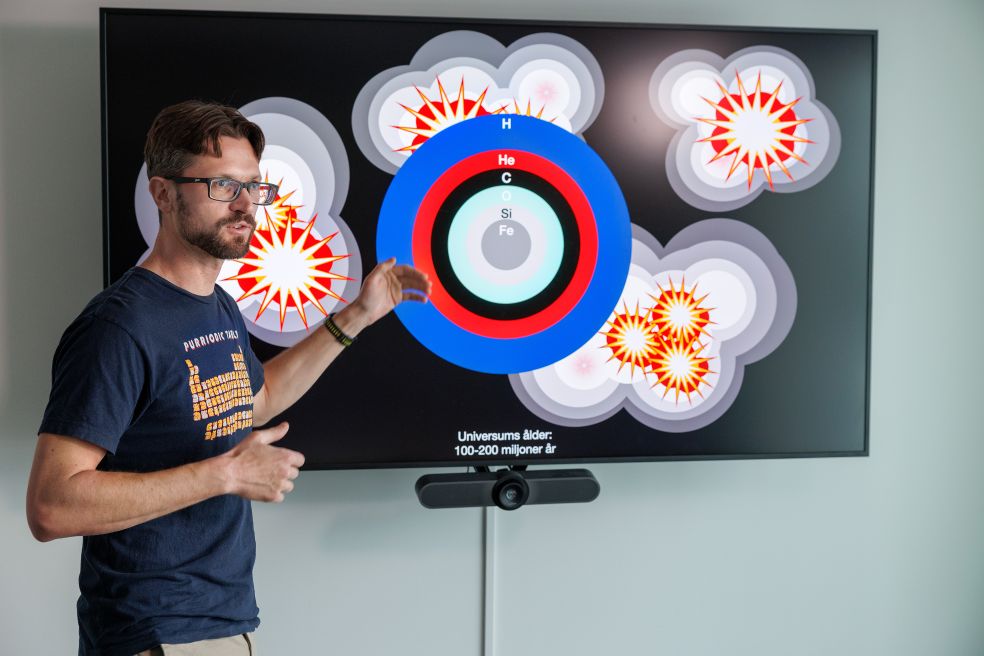
Virtually the only elements present in the early universe were hydrogen and helium. Heavier elements such as carbon, oxygen, magnesium and iron did not yet exist in any significant quantities. They formed inside stars and spread out into space when the stars died, often violently – as supernovae. In this way, the first stars laid the foundation for the chemical evolution that later made planets, and ultimately life, possible.
The problem is that the first stars have never been observed with any telescope. They probably existed for only a few million years – a very short time in cosmic terms. To find out what they looked like, how massive they were, and how they died, researchers must therefore adopt an indirect approach.
Time capsule
The key lies in what are usually referred to as “second-generation” stars. These formed from gas that had already been contaminated by the first supernovae. Their composition reveals the elements that were present in the gas when they were born – and thus also what traces the very first stars left behind.
“Each star of this type is actually a kind of time capsule,” says Nordlander.
Instead of digging in the ground, astronomers dig in starlight. When the light from a star is split into a spectrum, dark lines appear where certain wavelengths have been absorbed by substances in the star’s atmosphere. Each element leaves its own pattern, like a fingerprint. By reading these patterns, it is possible to determine which elements the star contains and in what quantities.
But it is a painstaking process. First, researchers must sift through enormous numbers of stars to find the most promising candidates.
We will be able to begin to describe what happened in the early universe before there were even galaxies similar to the Milky Way.
They search for extremely metal-poor stars, i.e., stars with very small amounts of elements heavier than helium. In astronomy, all these elements are considered metals, even carbon and oxygen. The lower the metal content, the greater the chance the star is very old, thus bearing an early chemical legacy.
Using modern large telescopes, researchers have managed to collect spectra from about a hundred ancient stars of this kind. But their observations are just the beginning. The real challenge is to interpret them correctly.
Developing methods
Nordlander is now developing and refining methods to drive the research forward. Many older analyses are based on simplified models in which the star’s atmosphere is treated as a stationary layer in a single dimension and where the gas is assumed to be in local equilibrium.
In the case of ordinary stars, assumptions of this kind can sometimes work reasonably well. For the most metal-poor and oldest stars, however, they can result in large systematic errors.
“If you’re off by a factor of 100, that’s obviously not great,” as Nordlander puts it.
He is therefore using far more realistic models in which the star’s atmosphere is described in three dimensions, as a dynamic environment where hot gas rises and cooler gas sinks – much like boiling water. The models also take into account that the interaction between light and matter does not always follow simple equilibrium assumptions.
Calculations of this kind require large datasets, advanced code and access to supercomputers.
A new picture of the early universe
The goal is not only to describe individual anomalous stars, but to build up a statistical basis that can change our picture of the early universe.
“Individual discoveries are a bit like collecting stamps, but I want to work toward creating an overall picture.”
If enough of these chemical time capsules are mapped, it becomes possible to begin answering questions that have long puzzled researchers. How massive were the first stars? Were their explosions so weak that only the lightest elements were ejected, or so powerful that even the heaviest were spread far out into space? And how did they influence the formation of the first galaxies – for example, the early evolution of the Milky Way?
Nordlander is pleased he can work on these research questions in Uppsala. It was here that he completed his PhD. After that, he lived for a few years in Australia and worked in a stimulating research environment. However, he wanted to return to the Swedish academic culture, which he describes as having a clearer sense of “we.” But without the Wallenberg Academy Fellow grant, it would hardly have been possible to carry out this large-scale project in Sweden.
“There are not many other funding sources in Sweden capable of providing the means to employ this many people,” he says.
The first stars are gone, but their chemical imprints remain. By reading and interpreting them with greater precision than before, Nordlander hopes to contribute to a better understanding of the early evolution of the universe. But this kind of research never really ends.
“We will never be completely finished. But we will begin to show what happened in the universe before we had galaxies like our own.”
Text Nils Johan Tjärnlund
Translation Maxwell Arding
Photo Magnus Bergström