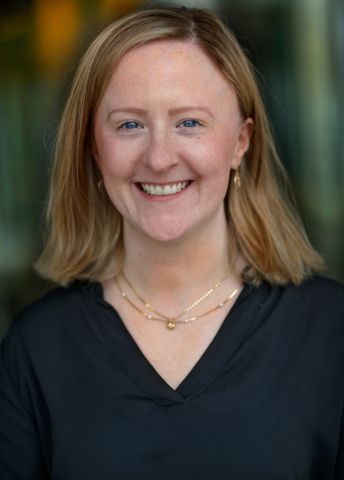
Oxygen-poor environments are spreading throughout the world’s oceans. They are home to microorganisms that impact ecosystems and the climate. At Uppsala University, Courtney Stairs is investigating how these organisms cooperate, which substances they exchange, and why their hidden lives may have global implications.
Courtney Stairs
Associate Professor of Cell and Molecular Biology
Wallenberg Academy Fellow 2023
Institution:
Uppsala University
Research field:
Biological and evolutionary processes in organisms adapted to oxygen-free environments
Oxygen is the very symbol of life. In our cells it is used to extract energy from the food we eat. But large parts of the Earth function differently. In deep oceans, lake sediments, and even in animal intestines, there are environments where oxygen levels are very low or there is no oxygen at all. Yet life there still flourishes.
These environments are inhabited by bacteria and archaea, as well as eukaryotic microbes, i.e., single-celled organisms with more complex cells than bacteria. Eukaryotes include animals, plants and fungi, but the majority of this diversity is microscopic and remains largely unknown.
It is these overlooked organisms that Stairs wants to understand better. She describes their world as the dark matter of microbiology.
“It is a very extensive world, and so far only a small part of it has been mapped.”
Stairs’ interest was sparked when she was a student, and discovered that some organisms can live without oxygen.
“It seemed to contradict everything I had learned from textbooks.”
Originally she had planned to become a physician, but fascination with the unusual metabolism of microbes and with broader evolutionary questions took over.
Dead zones teeming with life
In recent decades, oxygen-poor environments have become more common in oceans, coastal zones and certain freshwater systems. One of the main causes is eutrophication.
Oxygen-free environments that form in these aquatic systems are often called dead zones. The term is misleading, however. For animals and many other organisms, the change can be catastrophic, but for microbes that can live without oxygen, known as anaerobes, new opportunities arise, as Stairs points out:
“A dead zone is a new niche for anaerobes that can colonize it.”
So oxygen deficiency does not mean that life ceases; rather, it changes form, and the biological activity that begins can have effects far beyond the microbes’ own world.
Gases such as methane and nitrous oxide are produced in oxygen-poor environments. Methane is a potent greenhouse gas, and when microorganisms produce methane, some of it may eventually reach the atmosphere. The same processes also impact nutrient cycles in the ocean. This means that very small organisms can play a vital role in very large systems.
“It’s the microbes that do the work,” Stairs comments.
Flexible collaboration
Researchers already know quite a lot about bacteria and archaea in oxygen-poor environments, but the more complex eukaryotic microbes are much less understood.
One key question is how they can live at all without oxygen. When cells extract energy, substances are produced that must be removed for the process to continue. Humans accomplish this with the help of oxygen. In oxygen-free environments, other solutions are required.
Ultimately, it is about understanding how life functions when oxygen runs out, and what it means for our own world as these environments become more common.
One such solution is cooperation. One microorganism breaks down nutrients and disposes of substances that another microorganism can use. This may involve hydrogen gas, for example. Where one organism sees only waste, another sees a source of energy.
“One organism’s trash, in the form of hydrogen gas, becomes another’s fuel,” says Stairs.
This type of cooperation is called syntrophy, but the relationship between the microbes is not always as simple or fixed as might be imagined. Eukaryotic microbes can play several roles simultaneously. They can cooperate with bacteria, but also feed on them. As a result, they can influence the entire microbial community around them and, ultimately, the chemistry of the surrounding environment.
At the same time, there is much to suggest that these relationships are more fluid than the researchers previously thought. A clue emerged through an unexpected finding in the laboratory.
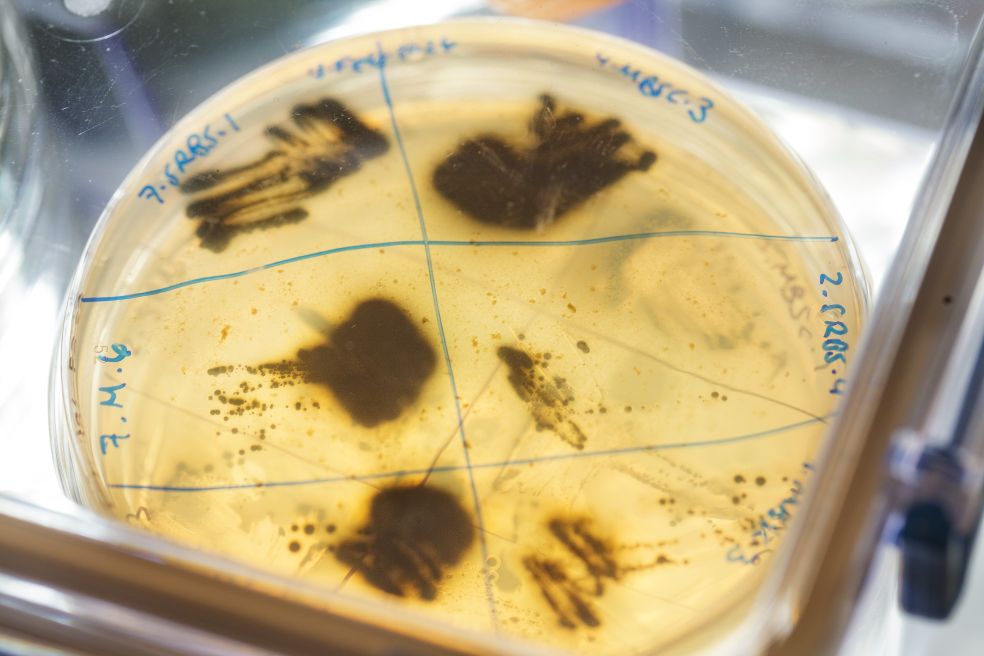
“We saw the cultures beginning to darken. That indicated that other microbial processes than we had expected had taken over.”
This led Stairs and her colleagues to think in a new direction. Perhaps the microorganism being studied is not tied to a particular bacterial species, but rather to a particular function.
“The organism doesn’t care which bacterium it is, but what the bacterium can do for it.”
From the laboratory to the ocean
This opens up a broader evolutionary perspective. Perhaps these microbes exist in an intermediate state where cooperation is flexible and not tied to a single partner. Studying these relationships enables the researchers to gain a better understanding of how flexible collaborations between organisms can develop into closer and more mutually dependent symbioses over time.
To this end, Stairs uses laboratory experiments as well as field studies.
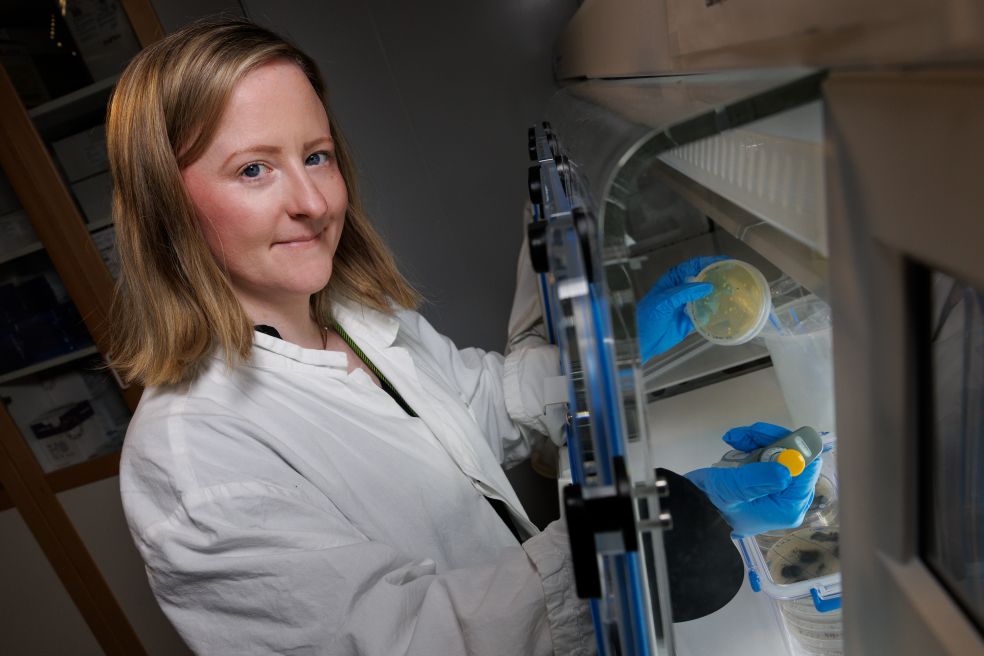
In the laboratory, the researchers build systems in which oxygen levels, temperature, salinity and pH can be carefully controlled. This enables them to monitor which substances the microbes produce and how interactions change as conditions shift. In the field, the same questions can be studied in real marine environments.
The researchers hope the project will provide a deeper understanding of how oxygen-poor environments function and why they are expanding. The findings may ultimately contribute to better assessments of how oceans and the climate will be impacted in the future.
Text Nils Johan Tjärnlund
Translation Maxwell Arding
Photo Magnus Bergström