As Arctic permafrost thaws, emissions of methane – a potent greenhouse gas – are rising. Örjan Gustafsson and his colleagues at Stockholm University are now investigating methane emissions from permafrost in the Arctic seabed. Their findings will provide a clearer picture of the global methane balance – and help societies to prepare for an increasingly vulnerable climate.
Project grant 2024
“Observational Constraints on Arctic Ocean Methane Systems as Tipping Elements and Triggers of Climate Overshoot (TippingArcticOceanMethane)”
Principal investigator:
Professor Örjan Gustafsson
Co-investigators:
Stockholm University
Wei-Li Hong
Birgit Wild
Institution:
Stockholm University
Grant:
SEK 25 million over five years
Around 10,000 years ago, large permafrost-covered land areas in the Arctic were flooded by seawater. Over millennia, remains of decaying plants and animals on the seabed have formed large quantities of methane – a greenhouse gas that plays a major role in global warming.
Since the industrial revolution in the 18th century, methane in the atmosphere has increased by 200–300 percent. This is more than the figure for carbon dioxide, which has increased by around 50 percent. Emissions continue. One example is the Arctic, where large wetlands release ever greater amounts of methane as permafrost thaws and glaciers melt.
Methane emissions are caused by both humans and nature. It is well known that emissions from agriculture, energy and waste can be reduced by mitigation and verified by measurements. But it is more difficult to ascertain how much climate warming triggers a rise in emissions from nature.
Addressing the knowledge gap
Gustafsson, who is a professor of biogeochemistry at the Department of Environmental Science and the Bolin Centre for Climate Research, Stockholm University, aims to address this knowledge gap.
He points out that anthropogenic (human-caused) global warming interacts with natural processes in the Arctic:
“This type of amplifying feedback mechanism will worsen climate change, but we cannot yet say by how much. We know that permafrost in the seabed is thawing faster than researchers previously thought – and that this releases growing amounts of methane.”
Reducing methane emissions is crucial to achieving the targets set in the Paris Agreement: to keep global warming well below 2 degrees. Methane is also part of the EU’s comprehensive legislative package aimed at reducing net greenhouse gas emissions by at least 55 percent by 2030, as compared with 1990.
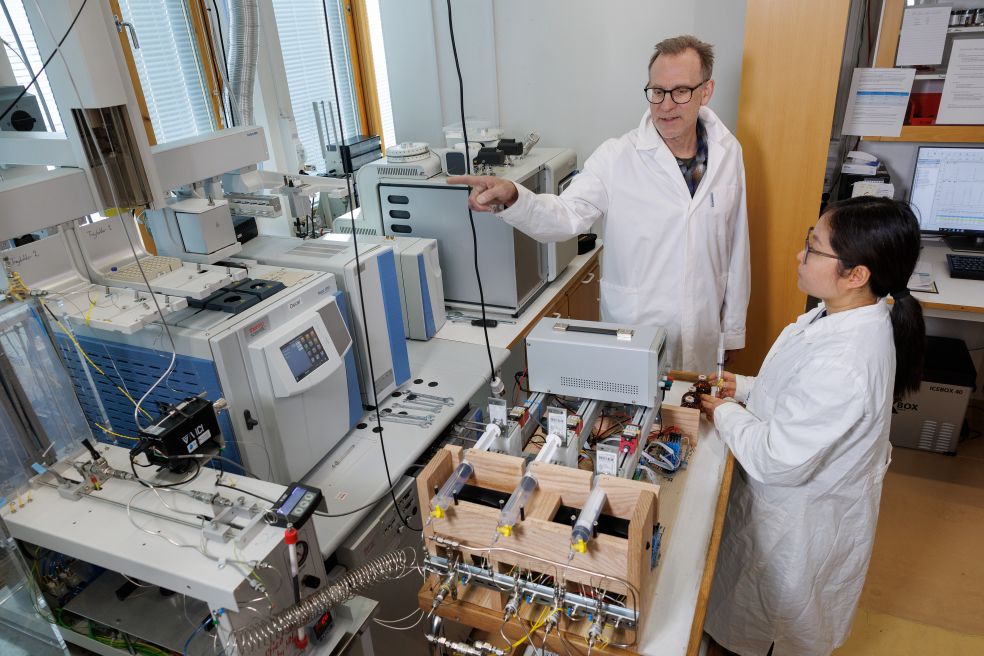
Gustafsson is now leading a project, funded by Knut and Alice Wallenberg Foundation, whose main objective is to generate new knowledge about methane leaking from sediments in the Arctic’s vast shallow seas. Questions they are addressing include: Where within the seabed does the methane come from? How much is seeping out and how much reaches the atmosphere and impacts the climate?
“Sweden are world-leading in Arctic research. The Wallenberg project enables us to remain at the forefront, and also ensures that we take several steps forward,” says Gustafsson.
Well-filled freezers
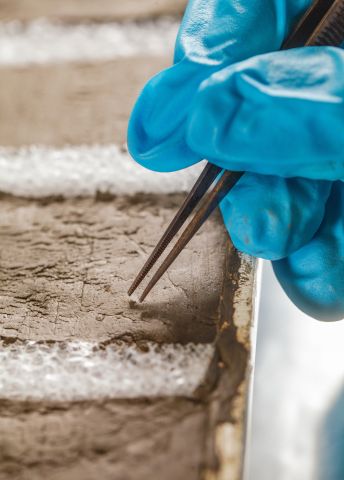
In the Geoscience Building on campus, there are several freezer rooms filled with thousands of samples taken from Arctic air, seawater and seabed sediments, mainly north of Russia.
The archive is probably the largest in the world, at least outside Russia. The material has been collected during several research expeditions. Gustafsson himself has been on four, two on the Swedish icebreaker Oden and two on Russian research vessels.
“Fieldwork is essential to make clear progress in research of this kind. We use many methods to find hotspots and collect samples for further study.”
The researchers have drilled down from the sea ice to the permafrost, enabling them to establish that permafrost on the seabed has thawed 20–30 times faster than permafrost on land.
They have several working hypotheses about the origins of methane found in seawater and rising into the atmosphere.
One is that the methane derives from organic matter from thawing permafrost; another scenario suggests that it has formed from collapsing methane hydrates, which may be described as a kind of frozen natural gas.
“If collapsing methane hydrates are the explanation, there is a high risk we will see a sharp increase in the amount of methane entering the atmosphere.”
Benefitting society
Gustafsson emphasizes how stimulating it is to work on a basic research project that also clearly benefits society. His research team will use the new knowledge they generate to create a scientific model to predict future methane emissions. This may help countries around the world to become better at preparing for inevitable climate change, and not the least to be able to build societies that are resilient to extreme weather.
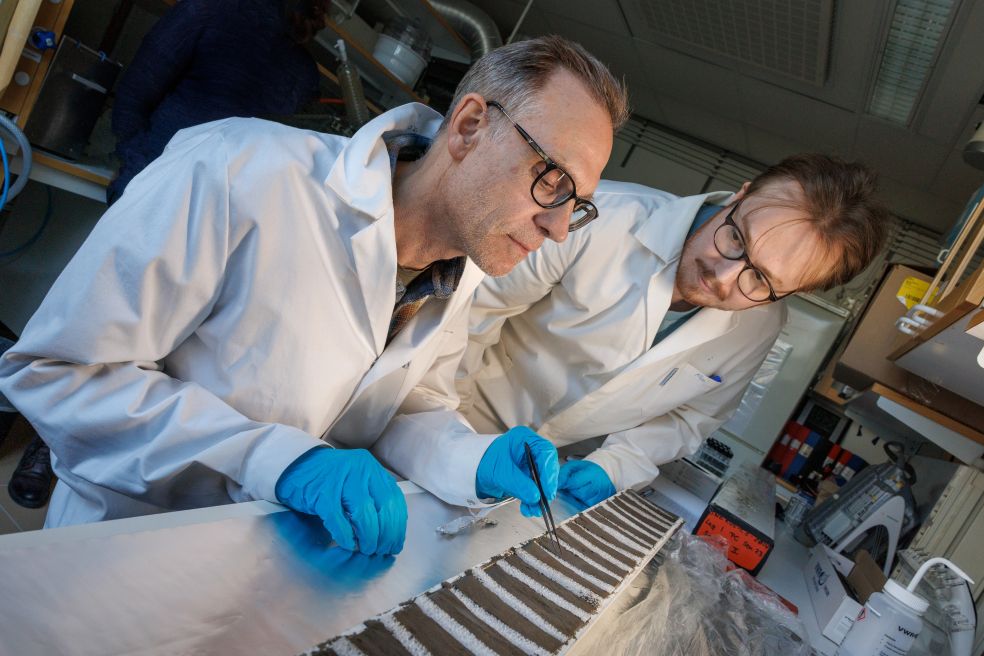
The researchers analyze isotopic signatures to determine where the samples come from, how old they are and how they have formed. The signatures act as a kind of fingerprint revealing from what system in the seabed the methane is leaking from.
“We have developed a new method, which now makes it possible to perform carbon-14 dating of methane molecules in seawater. This is the first time it has ever been done on this scale,” says Gustafsson.
The Wallenberg project also enables the researchers to examine the link between thawing permafrost in the seabed and ocean acidification in the Arctic. Among other things, the team will analyze molecular fossils of methane in decomposed microbes, organisms that live in the sediments and both produce and consume methane.
Text Ylva Carlsson
Translation Maxwell Arding
Photo Magnus Bergström