
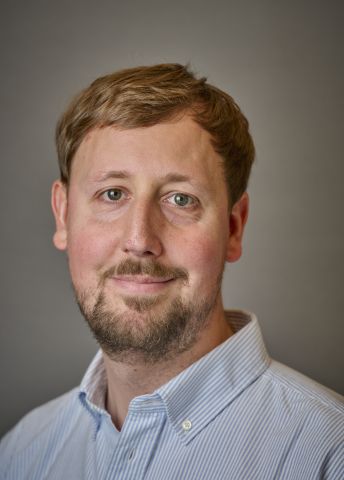
Wallenberg Academy Fellow 2025
Natural Sciences
Dr Aron Wennman
KU Leuven, Belgium
Nominated by KTH Royal Institute of Technology
Natural Sciences
Dr Aron Wennman
KU Leuven, Belgium
Nominated by KTH Royal Institute of Technology
Why do very different random systems follow the same pattern?
Wallenberg Academy Fellow Aron Wennman is developing mathematical models to explain statistical patterns that arise in very different phenomena: electrically charged particles, random matrices and heavy atomic nuclei’s energy levels. One important question is how systems that are seemingly very different in structure can nevertheless follow a common pattern?
In nature and physics, completely different systems can follow the same patterns or statistical laws. This allows them to be described using the same mathematical models, something mathematicians refer to as the principle of universality.
Dr Aron Wennman at KU Leuven, Belgium, is studying this phenomenon from a mathematical perspective. Its basis is a discovery made in the 1950s, when researchers realized that the energy levels in heavy atomic nuclei followed the same statistical pattern as the eigenvalues of a specific type of matrix with random numbers. Mathematicians now know that the same pattern appears in a mathematical function called the Riemann zeta function and in systems of electrically charged particles.
In his research, Wennman starts from what is known as a Coulomb gas, where repelling charged particles move freely in one plane. Coulomb gases are basic models in statistical mechanics, yet many fundamental mathematical questions about them remain wide open. For instance, researchers suspect that, at low temperatures, the particles in this gas crystallize to a hexagonal lattice – like the cells of a honeycomb. Another unresolved problem concerns how the gas behaves in geometric or topological transitions, such as when the particle cloud develops singularities or splits into several components. Wennman aims is to develop new mathematical methods to understand such phenomena.
As a Wallenberg Academy Fellow, Aron Wennman will work at KTH Royal Institute of Technology.
Photo: Patrik Lundin