
Program for mathematics 2026
Grant to recruit an international researcher
for a postdoctoral position
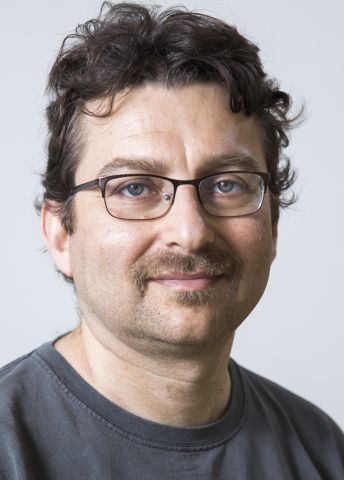
Professor Gregory Arone
Stockholm University
Grant to recruit an international researcher
for a postdoctoral position
Professor Gregory Arone
Stockholm University
Deeper algebraic description of shapes and spaces
Professor Gregory Arone will receive funding from the Knut and Alice Wallenberg Foundation to recruit an international researcher for a postdoctoral position at the Department of Mathematics, Stockholm University.
The subject of the project is algebraic topology. The origins of algebraic topology can be traced back to the mid 18th century and Euler’s formula for polyhedra, which states that for convex polyhedra, the sum of the number of vertices and faces minus the number of edges is always equal to 2. About 150 years later, the Frenchman Henri Poincaré succeeded in moving focus – from the study of angles and distances of classical geometry to the study of the fundamental structure of shapes, which is the domain of topology. In doing so, he laid the foundation of modern algebraic topology.
The field developed rapidly in the 20th century, with algebraic methods gradually becoming more sophisticated and abstract, as well as increasingly linked to other branches of mathematics. For example, algebraic topology was linked to mathematical analysis through the famous Atiyah-Singer index theorem on differential equations, which many people consider one of the great mathematical achievements of the 20th century.
Category theory developed out of the interaction between algebra and topology, and has now an indispensable tool, not only in algebraic topology but also in algebraic geometry, theoretical physics and computer science. Category theory’s calculus of functors can be regarded as analogous to the Newton-Leibnitz differential calculus for ordinary functions. For example, the usual polynomial functions correspond to so-called polynomial functors. The first goal of the project is improving the understanding of polynomial functors. A further goal is to develop the idea of a far-reaching analogy between polynomial functors and a central element of algebraic topology, known as equivariant stable homotopy theory.
Photo: Niklas Björling/Stockholm University