Our lives depend on cells communicating with each other. Researchers at Karolinska Institutet are now attempting to understand how groups of proteins on the surfaces of cells are structured, and how they interpret and transmit signals to their surroundings.
Project grant 2024
Next generation spatial membrane biology
Principal Investigator:
Björn Högberg, Professor of Molecular Systems Biophysics
Institution:
Karolinska Institutet
Co-investigators:
Karolinska Institutet
Ana Teixeira
Grant:
SEK 26 million over five years
Cells in our bodies constantly sense their environment and signal to other cells. These signals can trigger a multitude of biological processes in the body. Researchers are currently attempting to exploit this to identify new drug candidates.
In addition to signaling between one protein and another, known as “pairwise signaling,” cell signaling as a whole appears to involve additional processes.
Two research teams at Karolinska Institutet have demonstrated that even small assemblies of proteins on the cell surface, arranged in patterns on a scale of 10–100 nanometers, can play a major role in cell communication. They intend to gain a better understanding of these types of signaling pathways.
In a joint five-year project, funded by Knut and Alice Wallenberg Foundation, they will be developing methods to understand why protein clusters form, what their structures look like, and which biological functions their signaling initiates.
One of the teams will specifically investigate the significance of clusters of proteins that constitute insulin receptors in cell membranes, and whether these clusters can be selectively activated in fat and muscle cells, for example.
Structures believed to play a key role
“Transmission of a specific signal from cells often depends on an interaction between different proteins. But in many cases, the triggers for these interactions remain something of a mystery,” says Björn Högberg, Professor of Molecular Systems Biophysics at Karolinska Institutet.
He believes these interactions may be linked to the very structure of the protein patterns – the nanophysiology.
“That’s our main hypothesis – that how and where proteins are organized in the cell membrane may be crucial in this context,” he says.
The researchers are using high-resolution electron microscopes to observe these tiny patterns and their structure.
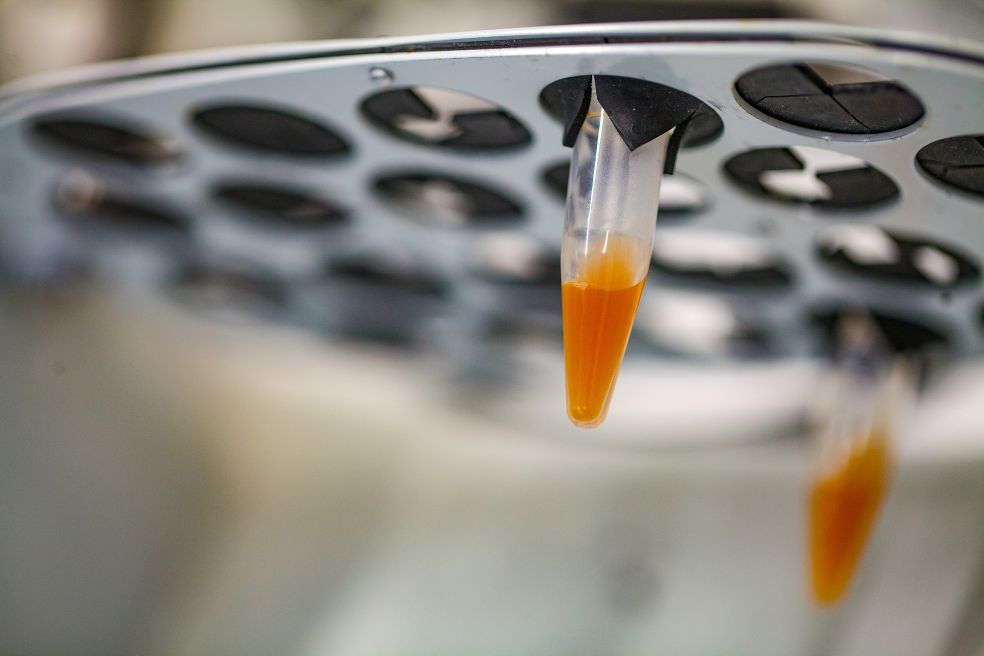
They are also using a method known as DNA origami to fabricate protein patterns resembling real ones to study how protein clusters signal to their environment.
This involves a process in which DNA is used as a construction material, and synthetic DNA is designed to fold into a geometric structure. Proteins can be positioned on these DNA structures, creating artificial protein patterns, which are then exposed to living cells.
“If we believe we know what effect a protein cluster has, we can use this method to see whether we are right. It’s like reading Braille and seeing whether it works,” says Högberg.
Over the next few years, he and Ana Teixeira will continue to develop the DNA technique with the aim of discovering more protein patterns and investigating their functions. Their goal is to succeed in characterizing “nanodomains of proteins on a large scale.”
“We want to be able to read billions of DNA strands simultaneously so we can discover how the nanophysiology of proteins affects our cells, diseases and human health,” says Högberg.
Triggering cell death
The research teams are particularly curious about specific bindings between molecules and protein patterns. They have identified a hexagonal pattern of proteins on cell surfaces whose function appears to be to program cell death – apoptosis – a biological process that causes cells to die in large numbers. Högberg believes that peptides – very small proteins – lead to apoptosis in these specific patterns.
He also reveals that when the researchers used these hexagonal patterns and exposed them to tumor cells in mice, the tumor tissue decreased by 70 percent. This finding is potentially significant for future cancer treatment.
Another possible application is based on clusters of proteins that constitute receptors for insulin molecules.
Teixeira’s team has experimentally mapped the structure of these insulin receptor clusters on the surface of fat cells. They then used this new knowledge to develop clusters of insulin molecules that can specifically target insulin receptors. The researchers hope these new findings will ultimately contribute to new treatments for diabetes.
They have also investigated how long a cluster of insulin can bind to a collection of insulin receptors in other cells.
It is known that when a single insulin molecule binds to an insulin receptor, the binding lasts only a few seconds at a time.
But in new experiments, Teixeira’s team discovered that clusters of insulin can bind to clusters of insulin receptors for several hours. This indicates that these clusters may have the ability to help stabilize blood sugar levels more durably than otherwise.
So far, this finding has only been confirmed in a zebra fish model, based on fish with induced type 1 diabetes and high glucose levels. The research continues, however.
“It was gratifying to see that we could use clusters of insulin in an entire organism and that glucose levels decreased,” Teixeira comments.
Text Monica Kleja
Translation Maxwell Arding
Photo Magnus Bergström