Almost 40 years have passed since researchers discovered that certain materials can become superconducting at temperatures far above absolute zero. Oscar Tjernberg is heading a project that aims to improve our understanding of how this is possible.
Project Grant 2024
Cooper-pair spectroscopy: A new window into the world of superconductivity
Principal investigator:
Professor Oscar Tjernberg
Co-investigators:
KTH Royal Institute of Technology
Egor Babaev
Yasmine Sassa
Institution:
KTH Royal Institute of Technology
Grant:
SEK 30 million over five years
Superconductors are materials that can conduct electric current without resistance. The phenomenon was discovered in the early 20th century in materials that were cooled close to absolute zero, i.e., minus 273 degrees Celsius. Much later, the same phenomenon was discovered in other materials but at considerably higher temperatures.
Established explanatory models now exist for superconductivity near absolute zero in many materials. But the classical models do not adequately explain superconductivity at higher temperatures.
“Superconductivity research is treading water. We need new tools to move forward,” says Tjernberg, professor of quantum materials at KTH Royal Institute of Technology.
Electrons form pairs
The explanation for superconductivity near absolute zero is to be found in quantum mechanics. The low temperature helps create a quantum state in the electrons, causing them to behave in a synchronized way, two by two, in what are known as “Cooper pairs.”
Although the electrons should repel each other, they are held together by atomic vibrations. But binding of this kind does not exist at higher temperatures in some superconductors. Yet the electrons form pairs – and no one really knows why.
“It’s very frustrating that we have spent more than forty years trying to understand how this works, without succeeding. There is much to indicate that completely different mechanisms underlie the binding, and it is very tempting to try to understand those mechanisms,” he says.
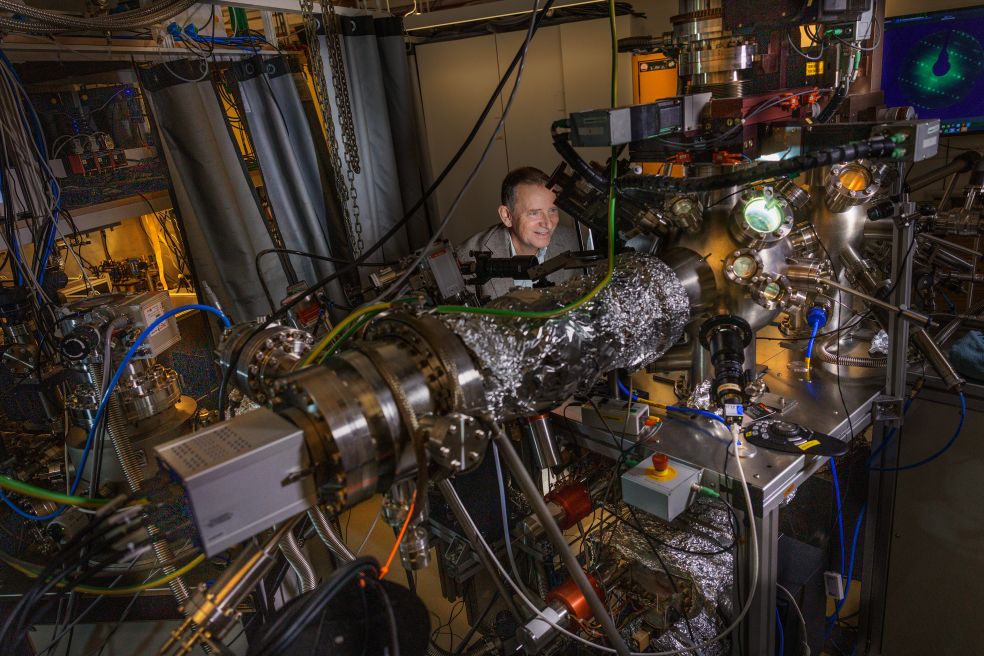
The project led by Tjernberg is based on previous research in which his team developed a technique to track how individual electrons move through a material. Using ultra-short light pulses, so short they are measured on the femtosecond scale, they were able to follow the interaction between electrons and atomic nuclei.
“Now we have modified our system to incorporate new features, including a different type of detector, to learn more about how the electrons pair up.”
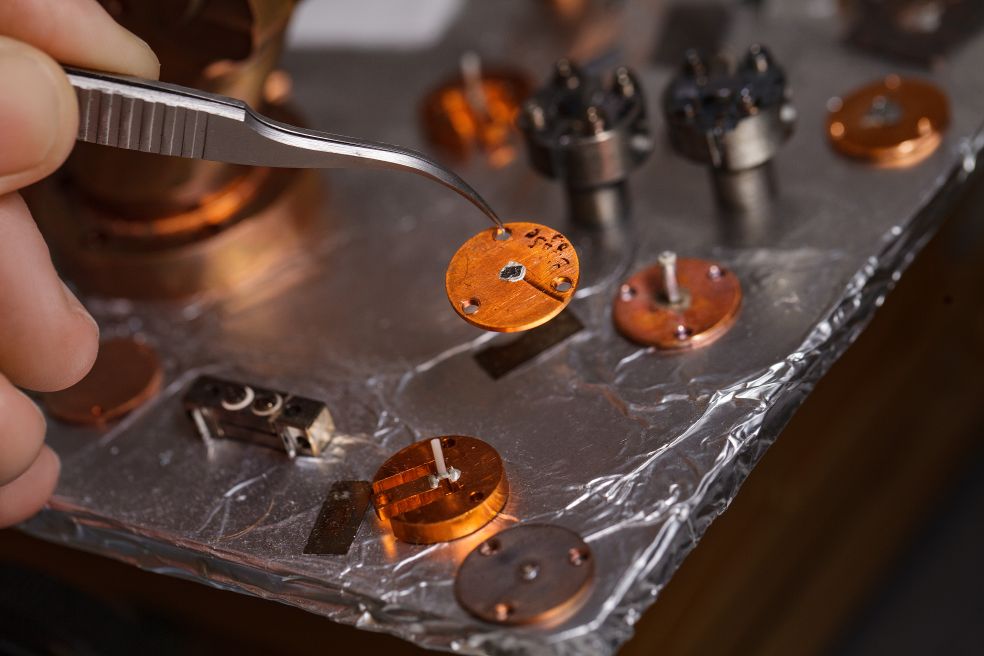
The possibility of detecting and characterizing both electrons in a Cooper pair simultaneously was proposed theoretically two decades ago. But it has proven very difficult to build the equipment required to succeed experimentally.
“It’s a very complicated experiment, and the probability of detecting an electron pair is very low. It has been estimated that it would take 100 years to obtain a measurement, which partly explains why so few others have tried.”
International race
Tjernberg is hopeful, however, because the team has developed a technique that can measure very small energy differences. With it, they can more clearly identify pairs where the electrons have exactly the same energy. The more precise the measurement, the more electrons can be generated and sorted.
But Tjernberg’s team is not alone in striving to reach this goal. At least two other international research teams have drawn the same conclusions and are building similar experiments.
“It’s positive in the sense that we all want to increase understanding of superconductivity. But it also introduces an element of competition and puts pressure on us to work faster.”
That time pressure makes setbacks in the work particularly stressful. Just a week or so before our visit to the lab, a water leak occurred. One of the connections to the cooling water sprang a leak and water was sprayed over the equipment. Fortunately, most of the sensitive electronics survived.
“After that, we had a power outage that damaged parts of the equipment. By now we should really have started the first tests to see whether our idea could work. Now we have to wait a little longer for the results.”
Sifting through the theories
If they succeed, the new facility could take the research one step closer to solving the mystery of superconductivity at high temperatures. There are various theories about the phenomenon. One leading contender is that magnetic fluctuations create an attractive force that binds the electron pairs together.
“We hope to generate more information to enable us to sift through the theories and reduce the number of explanations. Our goal is to get closer to a theoretical picture of how these superconductors work.”
Assisting him is Wallenberg Academy Fellow Yasmine Sassa, an expert in quantum materials with previous experience of the type of electron detection required. Also involved is Egor Babaev, professor of theoretical physics and one of the world’s leading theorists on superconductivity.
“Together we possess substantial expertise and experience. Both Egor and Yasmine have separate grants from Knut and Alice Wallenberg Foundation that create positive synergies. Those synergies are needed when working in such a competitive international field.”
The dream would be to recreate superconducting properties at room temperature.
“The holy grail we are all seeking is superconductors that do not require cooling. But practical applications presuppose they can be manufactured in volume and from commonly available and non-toxic materials. So there is much that needs to fall into place before we get there.”
Text Magnus Trogen Pahlén
Translation Maxwell Arding
Photo Magnus Bergström