Professor Timur Shegai is bringing together two research fields on a microscopic scale to control the interaction between light and matter. His research team is using tiny cavities to capture light and molecules in a complex dance that can be used to create difficult-to-achieve phenomena and new chemical reactions. The research paves the way for a wide range of applications: from drug development to sustainable energy solutions.
Project Grant 2024
“Tunable optomechanical microcavities with nanofluidic access for photochemistry under confinement”
Principal investigator:
Professor Timur Shegai
Co-investigators:
Chalmers University of Technology
Angela Grommet
Christoph Langhammer
Institution:
Chalmers University of Technology
Grant:
SEK 24 million over five years
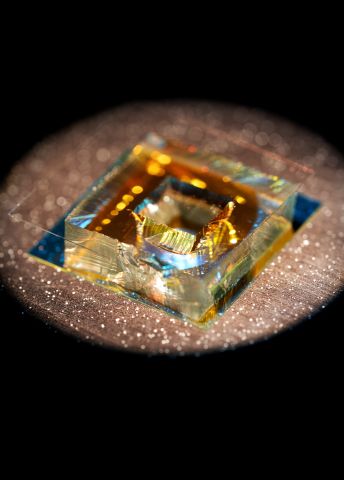
Microcavities are the extremely small cavities that lie at the center of Shegai’s new project, which is being funded by Knut and Alice Wallenberg Foundation. They can be described as resonators, or minute resonance chambers in which light bounces between the walls, just as sound reverberates in the sound box of a guitar.
The project combines nanotechnology with photonics in order to understand and control reactions all the way down to the nanoscale. When light and materials are explored on such small scales, entirely new properties and interactions can be studied. Shegai has spent many years investigating these phenomena.
“We want to create, understand and control photochemical reactions that are very difficult to achieve in other ways, in order to generate new, useful molecules. This could open up new opportunities in drug development, and could also have a bearing on the development of energy storage, sustainable energy solutions, and other applications,” says Timur Shegai, Professor of physics.
Minimal platform captures light meeting matter
In recent years, Shegai has taken important steps forward in his research by developing a versatile and flexible platform that captures light and molecules in an exciting interaction. The platform consists of two mirrors facing each other in a saline solution, at a distance corresponding to one hundred-thousandth of the width of a strand of hair. In the liquid between the mirrors, the tiny cavities are created that the researchers can use to explore the photochemical phenomena.
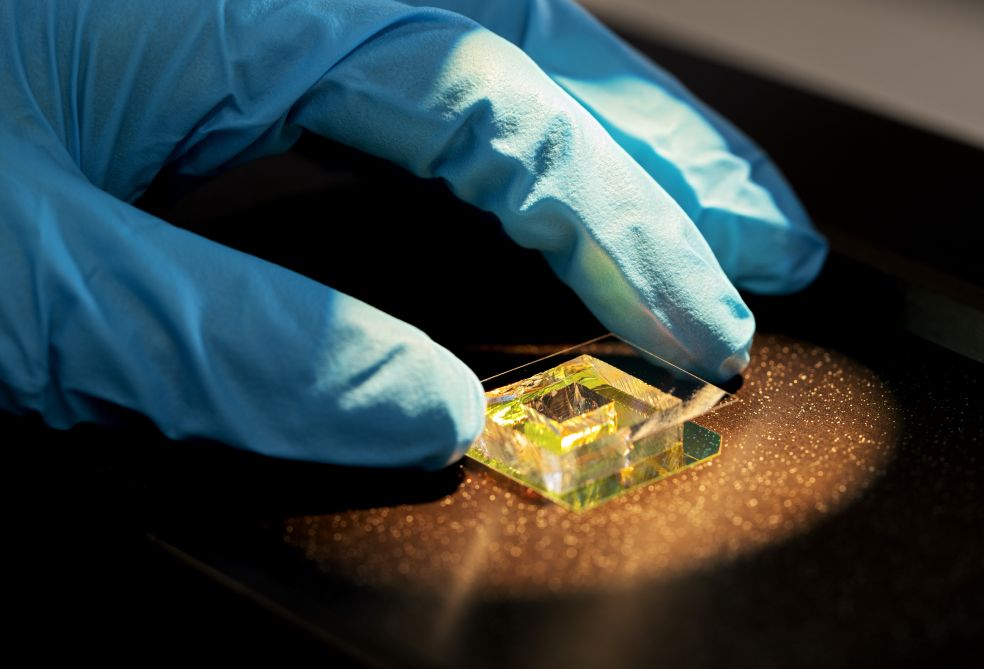
“It’s something of a miracle to work on such small scales, but it works. With these microcavities, we can induce light of different wavelengths and colors to circulate between the mirrors and interact with the molecules for a longer time. In this nano-world, this means that particles of light – photons – are eventually absorbed by the molecules. The process can be compared to a favorite Swedish pastime when the light and sun appear: we go out to sunbathe until the pigment in our skin absorbs the sunlight and gives us a suntan,” he says.
The platform also enables the researchers to increase the concentration of molecules, creating a very strong coupling between light and matter. Hybrid particles, known as polaritons, can then form, consisting of a mixture of light and matter. The researchers can use the polaritons to control and influence the photochemical processes, and the fascinating meeting between light and matter.
The different processes in the microcavities are, however, extremely sensitive and can collapse if the aqueous solution surrounding the cavities has either too high or too low a salt concentration.
“With too little salt, the system becomes unstable. Too much salt can kill it completely. So, we need to be like chefs in a good restaurant and make sure we use exactly the right amount of salt,” he says.
Better adjustability for different needs
In the new project, Shegai’s team will continue to develop and improve the platform to increase the efficiency and scope of the photochemical reactions. One priority is to improve the adjustability of the tool so the platform can create microcavities that can be adapted for different needs.
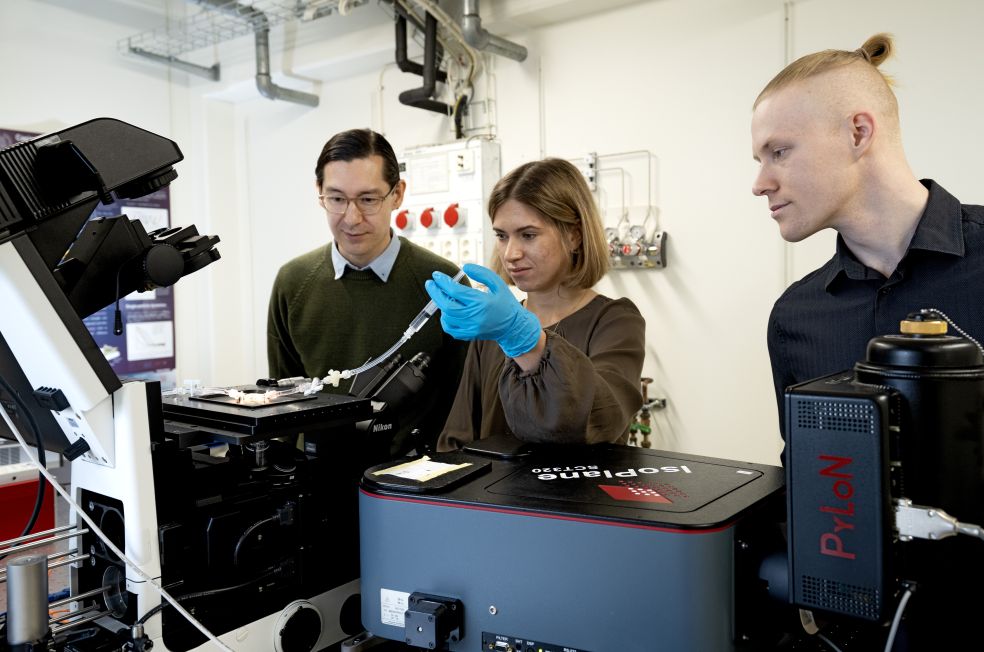
“This is a unique project involving a tough challenge, because it’s very difficult to control the light and the cavities on these nanoscale dimensions. But the project has a fantastic team with passionate researchers – Angela Grommet and Christoph Langhammer at Chalmers University of Technology. Together, we have exactly the right competencies needed to succeed,” he says.
Multiple future applications
In addition to generating new fundamental knowledge in physics and photochemistry, Shegai hopes the project will succeed in refining the platform to become an even better and more flexible tool for the development of new medicines. It is hoped that it will ultimately be possible to use it to study biological interactions in a highly precise way, for example within and between cells.
But above all, it is the collaboration within the project, both with senior researchers and with doctoral students, that is Shegai’s main driving force.
“I truly enjoy working with my colleagues in this project. And it feels good that this research will add to the knowledge possessed by new generations of researchers,” he says.
Text Ulrika Ernström
Translation Maxwell Arding
Photo Johan Wingborg