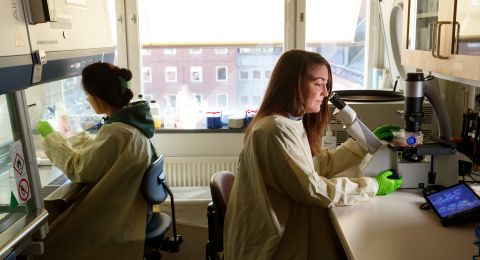
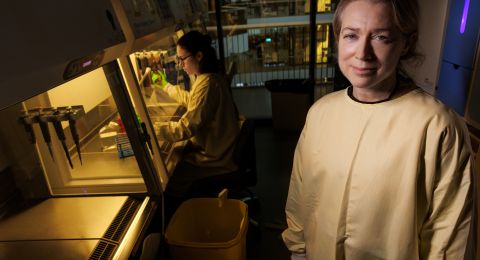
Wallenberg Academy Fellow Carmen Gerlach is breaking new ground in her view of the immune system’s T cells. Instead of dividing them into groups, she is studying how individual cells develop their unique properties. This offers potential for more effective vaccines and better immunotherapies for cancer.
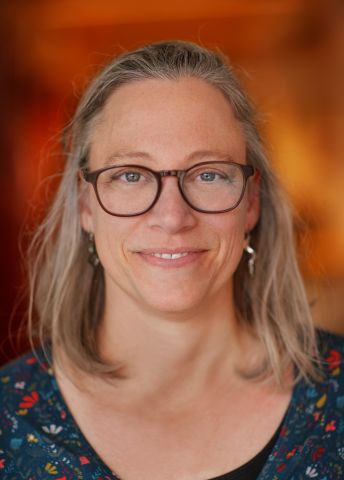
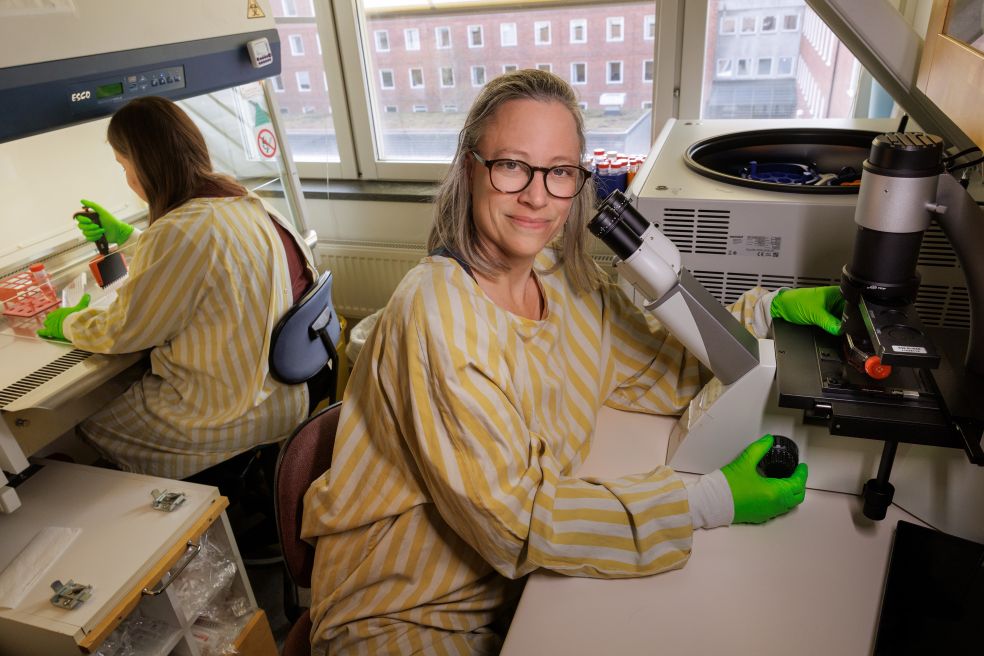
Carmen Gerlach
PhD in Immunology
Wallenberg Academy Fellow, extension grant 2024
Institution:
Karolinska Institutet
Research field:
Fundamental principles and mechanisms in the immune response of T cells, with a particular focus on CD8 T cells.
When we describe our immune system, it is tempting to resort to simplifications. In reality, it is a complex system in which different immune cells interact in a highly sophisticated manner.
Fundamentally, it consists of two different parts: an innate part and an adaptive part, the latter of which can remember the viruses and pathogens we have encountered in our environment. T lymphocytes or T cells – a type of white blood cell – are an important part of the adaptive immune system.
T cells can perform multiple tasks in the fight against an invader. Traditionally, research has divided T cells into subgroups that strictly correspond to one, or a fixed combination of their functions. But Gerlach believes that dividing them into groups is too great a simplification and leads research in the wrong direction.
“Our biology is far more complex. The diversity among our T cells is much greater than we have assumed, and it is therefore misleading to divide them into predetermined groups or boxes that only consider a part of each T cells function,” says Gerlach, who is a senior researcher at Karolinska Institutet.
Different characteristics
Instead, we should see T cells more as individuals with different characteristics. This perspective can be likened to the way we view human traits. We all carry different knowledge and experiences that can help us perform various tasks. In the same way, individual T cells possess characteristics that make them more or less suited to certain tasks.
The characteristics of T cells can also change during their lifespan and influence their ability to perform a given task.
“We’re leaving the boxes behind and developing a new framework that can show and explain how different T cells acquire their characteristics,” says Gerlach.
The framework forms the basis for a way of monitoring T cells developing into multiple dimensions/directions in parallel rather than dividing them into groups. Her research team has already mapped several directions, one of which produces T cells that are better than others at killing infected cells or invaders.
My driving force is to continuously increase knowledge of how our biology works. One of the worst feelings I know is the sense that we’re not doing as well as we could because we lack knowledge.
Gaining a deeper understanding of how T cells develop their properties has several advantages: better vaccines, new treatments for autoimmune diseases, and more effective cancer therapies.
Better vaccines and cancer therapies
After the COVID-19 pandemic, the new mRNA vaccines gained widespread acceptance. They activate the T cells more quickly and effectively. Gerlach believes that with greater knowledge of how T cells get and adjust their properties, tomorrow’s vaccines may be even better at generating the right kind of T cells:
“When we know which types of T cells work best and how they develop their properties, it will be possible to design more effective vaccines and also more effective immunotherapies for cancer,” she says.
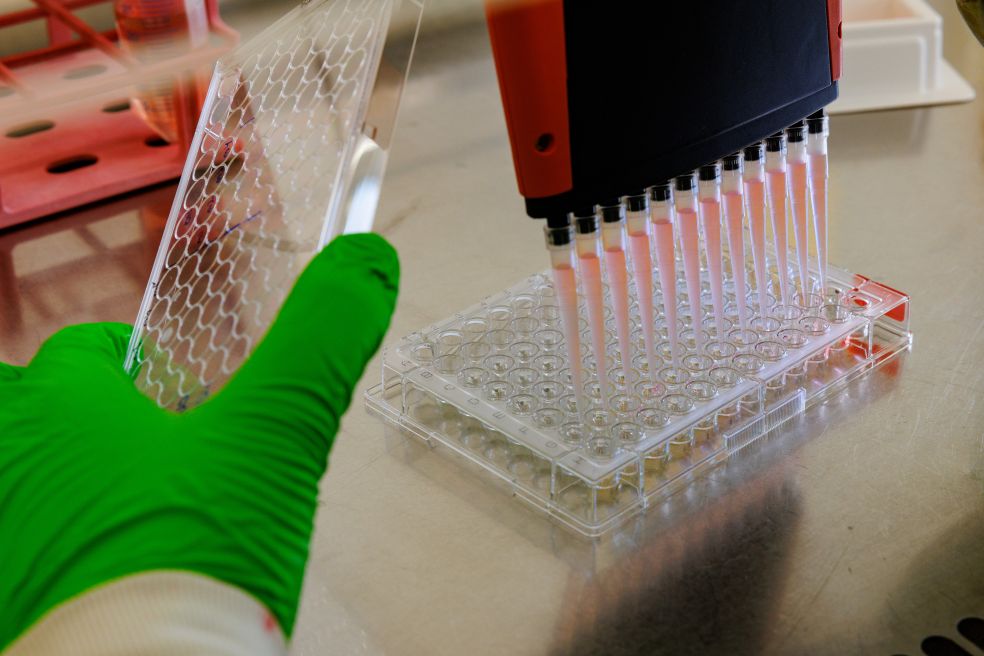
But the new methods to measure a T cells’ properties must not be too complicated or expensive. The best approach is to use single-cell sequencing. But it is an expensive technique that requires great skill to use. For Gerlach, flow cytometry is the key – a technique devised as far back as the 1960s.
“When I started using flow cytometry, it was revolutionary that we could look at four proteins. Now the technology has improved greatly, and we can measure up to 40 proteins per cell.”
The technique enables scientists to analyze individual cells at extremely high-speed using fluorescent antibodies. It has found broad application in everything from cancer diagnostics to stem-cell research and the development of new drugs.
Encountering resistance
However, it is not easy to introduce an entirely new way of describing the diversity among cells that researchers have worked on for decades. When presenting her ideas at research conferences, she has sometimes been met with resistance.
“Some have objected to our model and said we are drawing conclusions that go too far. But when we explain it in detail, most of them change their minds and see the advantages of our approach.”
The next step is to use the framework to understand which types of T cells work best when treating an individual patient. To take that step, more clinically oriented researchers will be needed.
Alongside her position at Karolinska Institutet, she has a role at the Leibniz Institute for Immunotherapy in Germany. This gives her access to knowledge that improves the prospects of advancing the mapping of T cells.
Gerlach emphasizes the importance of collaboration between researchers if advances are to be made. She compares the research community to a large group of people trying together to solve a giant Sudoku puzzle. Each person contributes a number that makes it possible to take the next logical step toward the solution.
Text Magnus Trogen Pahlén
Translation Maxwell Arding
Photo Magnus Bergström