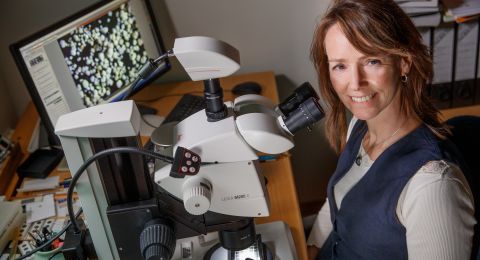
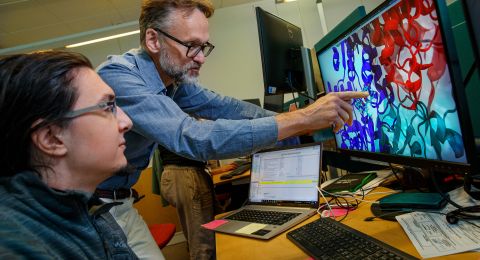
Lake shore areas have long been difficult to explore and have therefore often been left out of carbon budget calculations. Drones are now being used as a tool to map these shoreline zones. The models being developed may yield entirely new insights into the role of lakes in carbon storage and greenhouse-gas emissions.
Project grant 2024
Connecting the shore to the lake: towards revised carbon and greenhouse gas budgets of lake and land ecosystems (RELITORATE)
Principal investigator:
Professor Sebastian Sobek
Co-investigator:
Linköping University
David Bastviken
Institution:
Uppsala University
Grant:
SEK 32,000,000 over five years
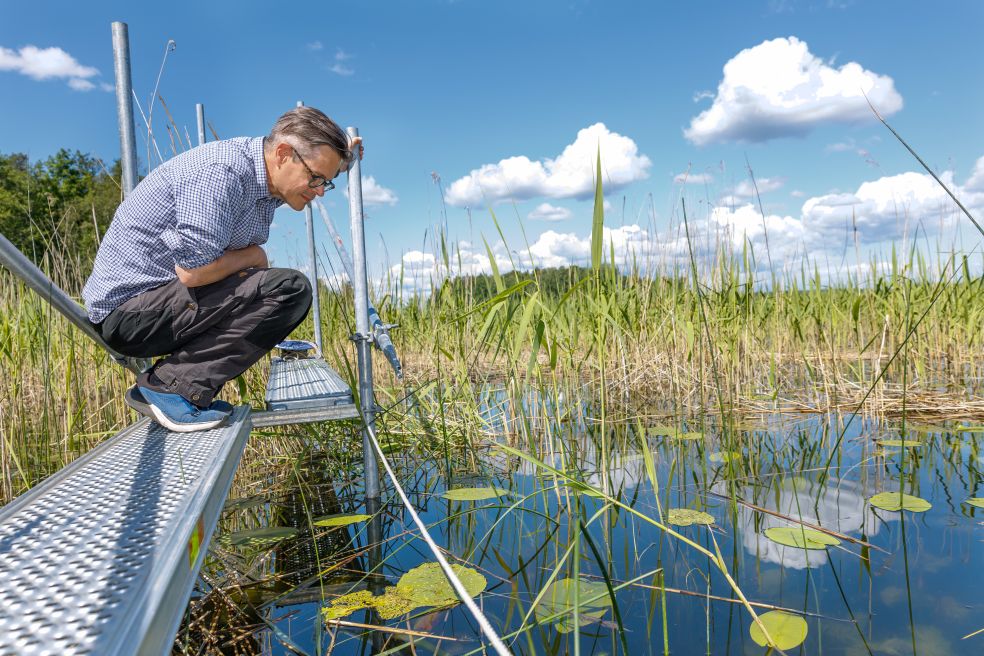
As summer approaches, aquatic plants along lake shores come to life. Activity increases dramatically in the shallow, nutrient-rich bottoms, and the researchers want to be there when it happens.
“We carry out field measurements during different seasons, including when vegetation along the shoreline zone begins to flourish,” says Sebastian Sobek, Professor of Limnology at Uppsala University.
Together with David Bastviken at Linköping University, Sobek is heading a research project adopting a new approach to the zone where land meets lake. Scientifically speaking, this boundary is called the littoral zone, a common ecosystem in a lake-rich country such as Sweden.
Shoreline areas are difficult to access and have therefore often been excluded from monitoring programs. In dense reed beds it is barely possible to move forward by boat. From land, it is easy to sink into soft sediments. Plants may be several meters tall or grow entirely below the water surface with extensive root systems in the lakebed.
“I have studied these processes throughout my research career. But I have often skipped the shoreline zones because they are so messy and difficult to work in,” says Sobek.
Carbon stored and released
The researchers are combining monitoring in the field with remote sensing and modeling. They will measure the occurrence of carbon dioxide, methane and nitrous oxide, determine how much carbon is stored in the sediments, and map the extent of shoreline zones.
Shore plants absorb carbon dioxide from the air as they grow. When the plants decompose, the carbon can return to the atmosphere as carbon dioxide, or as methane if the environment is oxygen poor. Methane is a much more powerful greenhouse gas than carbon dioxide. Some of the carbon is also buried in bottom sediments, where it can be stored for a long time.
This means the shoreline zone can act both as a source of greenhouse gases and as a carbon sink – that is, it can store more carbon than it releases. Sobek and his colleagues want to better understand that balance.
To access sediments in densely vegetated shoreline zones, the researchers have developed a special sampler equipped with a circular cutting blade. During winter it has been used in Lake Erken, north of Norrtälje, when the ice makes it possible to reach places that are otherwise difficult to study.
“Previously, roots often stopped our sampling efforts. Now we can take samples systematically in environments that are very difficult to access.”
Sediments provide a different timescale from gas measurements. Gas exchange can change from week to week. In June, when plants are growing vigorously, carbon dioxide uptake may be high. In late summer and autumn, growth declines, plants decompose and methane production may increase. Bottom sediments, however, accumulate year after year and carry traces of processes that have been ongoing for a long time.
Two lakes – two environments
Two very different lakes are at the center of the project. Lake Erken is a clear, fairly large lake at which Uppsala University has maintained a field station since the 1940s. Existing monitoring series from the open water are a major asset, allowing the researchers to devote more effort to the less-studied shoreline zone.
The other lake is Lake Erssjön near Trollhättan in the west of Sweden, a small lake with dark, humus-rich water from surrounding peatlands. There, light does not penetrate as deeply, affecting the conditions for plant life.
“By comparing two such different lakes, we can learn which processes are general and which depend on the specific characteristics of the lake,” says Sobek.
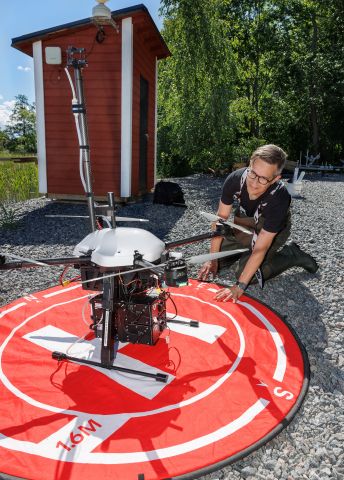
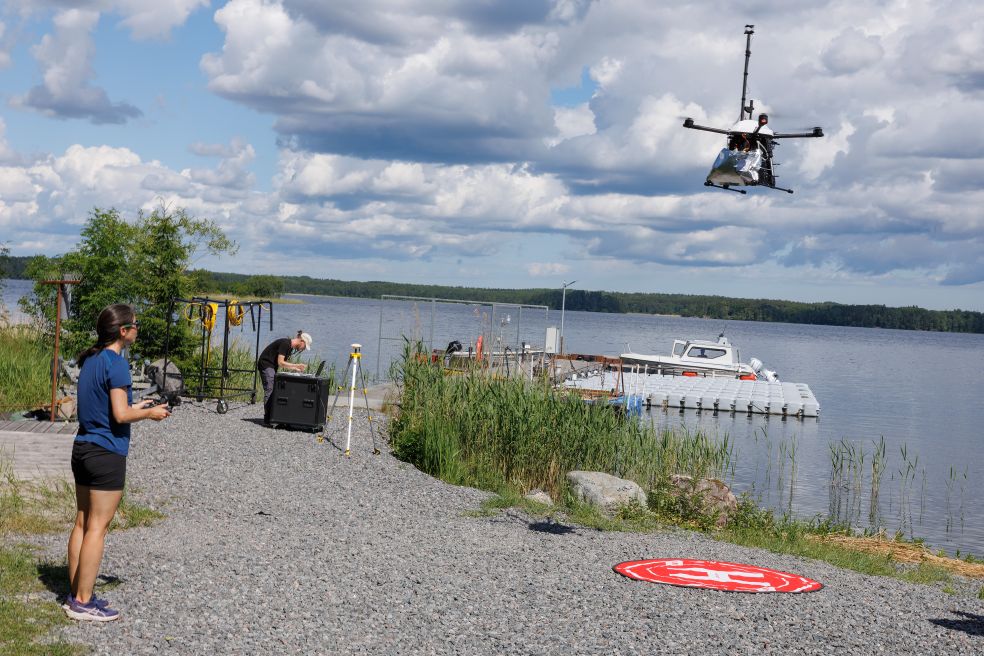
The tools used by the researchers include satellite imagery and drone technology. Previously, gas exchange was often monitored using chambers or bags placed over plants or water surfaces – a cumbersome method.
“We can use drones to monitor greenhouse gases without having to force our way into the vegetation. We can ask questions that used to be very hard to answer.”
The role of lakes in climate
In the long term, the research may impact our understanding of the role of lakes in the climate system. In a study published in Nature Geoscience, Sobek and fellow researchers have already highlighted that the global carbon budget of lakes may change significantly if shoreline zones are included. Lakes that were thought to be net sources of carbon may instead prove to be carbon sinks.
Those calculations were based on limited data, however. The current project will provide more systematic measurements. But this does not mean the new results can automatically be incorporated into large climate models.
“The large models operate on scales of tens of kilometers, whereas we are studying processes at the local level,” says Sobek.
The aim is instead to build and test models for different lake types and then gradually scale up the knowledge.
“Globally, lake shorelines are estimated to extend over seven million kilometers, which is four times longer than the coastlines bordering the world’s oceans. So the impact on the climate could be substantial.”
The species-rich littoral zone is also important for biodiversity. Many fish use shallow vegetated areas as spawning and nursery habitats.
“If our preliminary calculations are correct, the shoreline zone may also play a larger role in the climate than we previously thought by exerting a cooling effect. And that is precisely what we now need to measure properly,” says Sobek.
Text Nils Johan Tjärnlund
Translation Maxwell Arding
Photo Magnus Bergström