The smallest galaxies in the universe contain unusually large amounts of dark matter – the invisible and unknown matter believed to make up most of the universe. Wallenberg Academy Fellow Azadeh Fattahi aims to gain a better understanding of dark matter by modelling how these dwarf galaxies form and evolve.
Azadeh Fattahi
Doctor of Astronomy
Wallenberg Academy Fellow 2023
Institution:
Stockholm University
Research field:
Cosmological simulations of dwarf galaxies
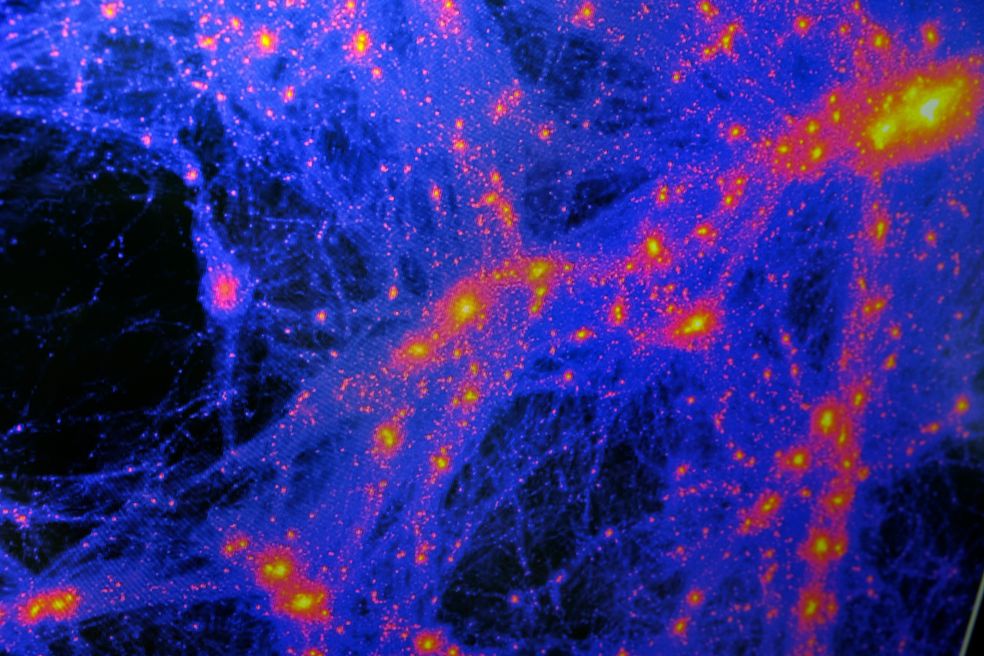
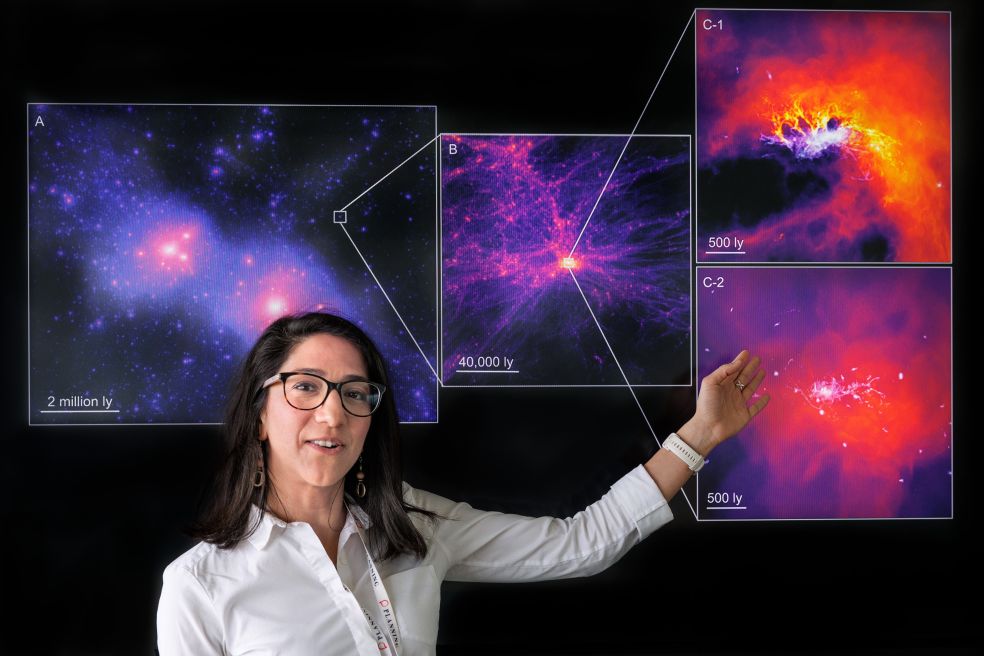
“Here we see the Milky Way and the Andromeda Galaxy and lots of small clumps of dark matter. That is where the dwarf galaxies exist,” says Fattahi, showing an image on her computer.
Fattahi is a researcher at the Oskar Klein Centre at Stockholm University. There she works on understanding one of the universe’s mysteries – dark matter.
We don’t actually know what most of the matter in the universe, around 80 percent, is. We call it dark matter because it neither emits nor absorbs light.
Although dark matter is invisible to us, we can find the evidence for its existence. Stars and galaxies, for example, would not move as they do if they were not affected by the gravitational force of dark matter.
Providing answers about dark matter
According to current theories, dark matter accumulates in structures called halos. They serve as an invisible framework in which stars and galaxies can form, and every galaxy is embedded in a halo of dark matter.
Fattahi’s research is about understanding dark matter using the universe’s smallest galaxies, dwarf galaxies. These are relatively simple systems and also contain a high proportion of dark matter, so they are important tools for studying the properties of dark matter.
In recent years, more and more dwarf galaxies have been discovered with telescopes, but it is still difficult to understand how they form and evolve. Fattahi is developing detailed computer simulations that follow the evolution of the universe from the Big Bang to the present day in order to see how dwarf galaxies emerge.
“Dwarf galaxies serve as a laboratory in which we can study how dark matter behaves. We can assign different properties to dark matter in the simulations and see how this affects the galaxies,” she says.
The researchers compare the simulations with observations of dwarf galaxies, enabling them to test which models of dark matter best correspond to reality. The simulations can also be used to explain observations and predict what future telescopes should be able to detect.
High level of detail
To study how dwarf galaxies form, account must be taken both of the large-scale evolution of the universe and small-scale processes inside individual galaxies. Fattahi is therefore using a model based on simulating a large region of the universe in relatively low detail in order to include the cosmic environment. The researchers then zoom in on a smaller region, such as an individual dwarf galaxy, and increase the level of detail. There, the model includes all known physical processes related to galaxy formation, such as star formation, supernovas and black holes.
“Simulating the entire universe at the same high resolution would require far more computing power than is currently available. Even with the supercomputers we use, each simulation takes several weeks.”
Dwarf galaxies can contain a thousand times more dark matter than visible matter.
When we meet, Fattahi has just published the first results from simulations using the group’s galaxy formation model. She is enthusiastic about the findings.
“So much exciting work lies ahead. We see that dwarf galaxies are very sensitive to conditions in the early universe. But we also see things we want to improve in the next simulation, both as regards galaxy formation and how we describe dark matter.”
One challenge she faces is that the physical processes surrounding galaxy formation are not completely understood. She elaborates:
“If the simulation does not match the observations, it can be hard to know whether this is due to our assumptions about dark matter or to uncertainties in the physics of galaxy formation. I think about this a lot when designing our experiments and interpreting the results.”
Broadly speaking, three models of dark matter are often talked about: cold, warm and self-interacting. Investigating these more closely is one of the goals of the research.
“In four years’ time, I hope we will have simulations that investigate all three dark matter models and that we will be able to predict what signatures they should produce in future observations.”
Fattahi stresses that her research is very much a team effort. The basic model used in the simulations was developed by a collaborator at the University of Hawaii, and the research team is also working with researchers in the United Kingdom and Germany.
Astronomical mother
Fattahi was born and raised in Iran, near Tehran. Her interest in astronomy was awakened in childhood.
“My mother used to point out constellations and planets in the sky and gave me books about stars and galaxies to read.”
Her interest endured, and she studied physics at the Sharif University of Technology in Tehran. She later earned a doctorate in astronomy at the University of Victoria in Canada. She then worked as a postdoctoral researcher and faculty member later on, at Durham University in the United Kingdom before moving her research to Stockholm University.
When she is not working, Fattahi usually attends fitness classes or goes to the gym, dances tango, and enjoys reading books.
“Sitting in a café and reading is one of my favorite weekend activities.”
Text Sara Nilsson
Translation Maxwell Arding
Photo Magnus Bergström