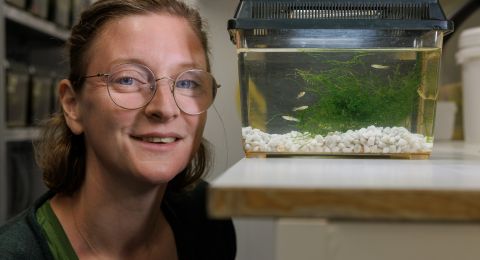
What can guppies and their parasites reveal about the occurrence of pandemics? Researcher Jessica Stephenson is studying the interplay between social behavior and the spread of infection.
Jessica Stephenson
PhD in Biology
Wallenberg Academy Fellow 2023
Institution:
Stockholm University
Research field:
Infection biology, evolutionary biology and ecology: Development of infectious diseases and evolutionary parasitology
Gyrodactylid parasites – flatworms or flukes – are small, transparent, and attach themselves to the skin and gills of fish, sometimes in large numbers. The parasite feeds on the skin and fins of the host, often causing a fatal infection. In Norwegian fjords and in rivers on the Swedish west coast, for instance, they have caused major problems for salmon populations.
In Trinidad, off the coast of Venezuela, wild guppies are also affected on a large scale. For over ten years, British biologist Jessica Stephenson has studied the interaction between guppies and parasites in order to understand how pandemics arise, most recently at the University of Pittsburgh in the U.S.
She is a Wallenberg Academy Fellow, and since the summer of 2025 she has been pursuing the same exciting line of research at the Department of Zoology at Stockholm University.
“Our overarching research topic is to understand how host social behaviors influence the transmission of parasites.”
Chooses its victims
However, her research also suggests that the parasite selects which fish to attack in order to optimize its ability to exploit the host, or in other words its virulence. When a host has been exhausted, the worms release their hooks and move on to a “more nutritious” host.
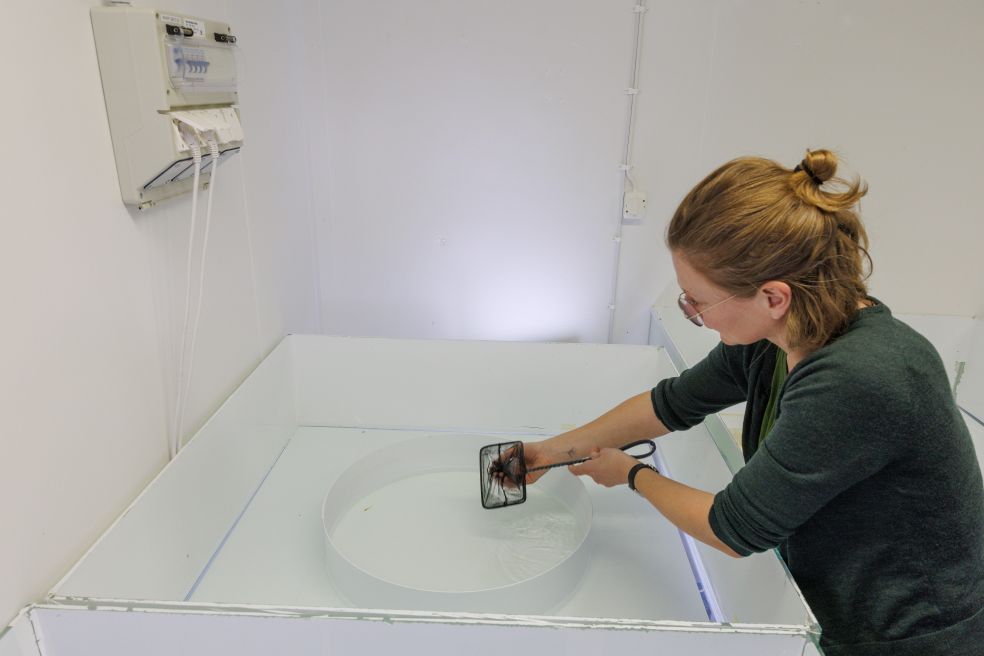
In the U.S., Stephenson used a studio with cameras to film individual guppies swimming in white aquariums. She and her research team are now installing similar equipment in a laboratory at the Department of Zoology.
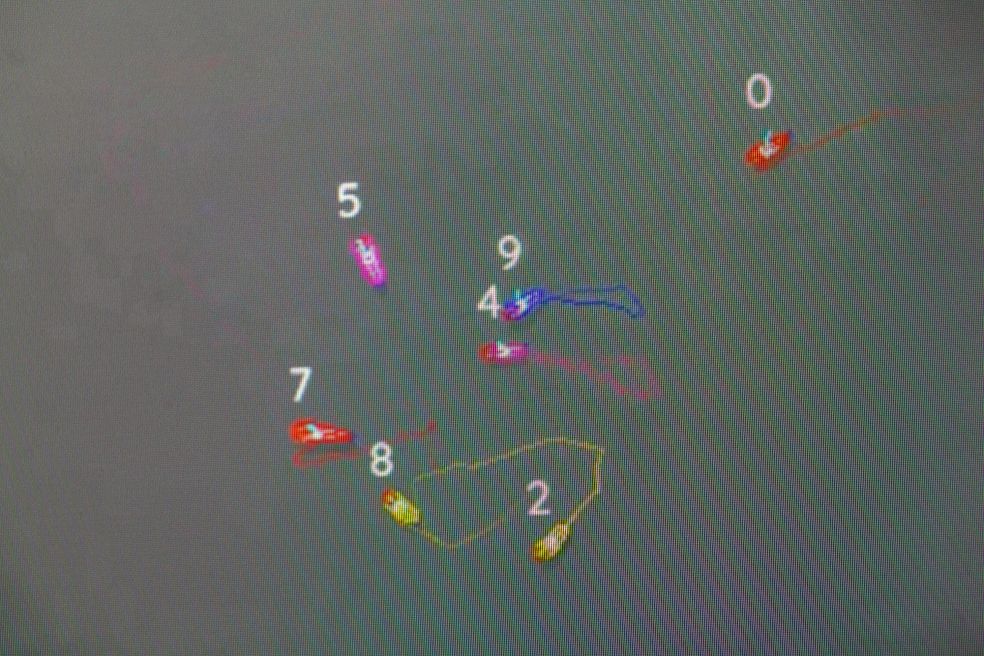
The cameras are connected to a computer with advanced tracking software that enables the researchers to follow each fish individually. Stephenson runs a video in which each individual guppy can be seen swimming around as a graphic avatar, each with its own color.
The experiments involve placing an infected guppy together with healthy guppies in the aquariums. The researchers then use the cameras to carefully monitor how the fish behave and the patterns by which the worms spread.
“The outstanding resolution of the cameras enables us to see which fish interact with which, how close they are to each other and for how long. We can actually measure how many worms take advantage of the interaction to transmit without having to destroy either the host or the parasite,” she explains.
In order to do so they anaesthetize the fish and pull all the fish out each day and count the worms, and pull them back.
Detecting sick fish
It has previously been extremely difficult to demonstrate the role played by host behavior in parasite transmission, but the group’s methods have generated large quantities of new data. Stephenson is now able to confirm that social behavior can play a key role in the spread of infection.
Within a day of being placed in the aquarium, the infected guppy is usually detected by the healthy individuals. Exactly how is not entirely clear.
The outstanding resolution of the cameras enables us to see which fish interact with which, how close they are to each other and for how long.
“They have good vision, including excellent color vision. But infected fish may also release a scent in the water that other fish can probably detect.”
The guppies’ reactions to the infected fish vary. Some swim close to it; others avoid it. This variation may be linked to the immune systems of individual fish.
“We have managed to gather some evidence that the fishes’ behavior is linked to how sensitive an individual fish is to the parasite.”
The number of parasites a fish carries and how well these reproduce is also a measure of the fish’s resistance. The immunological aspect is something Stephenson would like to examine further, perhaps using zebra fish.
Not all guppies die from parasite infestation: some become chronically ill; others recover.
“We know there is also a genetic component that reduces the risk of infection and that some microbes on fish skin provide protection, whereas others worsen the infection.”
Heatwaves may increase spread
Climate, sunlight and water currents also play a role in this context.
“As climate change progresses, we see more and more infectious diseases emerging and becoming established; this applies both to humans and wild animals. The trend is accelerating as the ranges of species change in line with their attempts to find new habitats to which they are adapted,” says Stephenson.
The researchers have therefore also examined the role heatwaves play in the spread of parasites among guppies.
“In some cases they spread extremely quickly, faster than under conditions without a heatwave, and in other cases not at all. The outcome appears to be determined by how the fish interact at higher temperatures.”
To study the impact of environmental factors, Stephenson plans to conduct field studies on guppies in their natural habitat in Trinidad.
“It is always important to check that the patterns we observe in our lab experiments are actually relevant to the natural system. The food is also amazing!”
Text Monica Kleja
Translation Maxwell Arding
Photo Magnus Bergström