Computer simulations are increasingly replacing expensive experiments and are used for everything from predicting climate change to understanding how the human body functions. Reliable simulations require advanced mathematics. Wallenberg Academy Fellow Sara Zahedi is developing computational methods, driven by a desire to find solutions with a broad application.
Sara Zahedi
Professor of Numerical Analysis
Wallenberg Academy Fellow, extension grant 2024
Institution:
KTH Royal Institute of Technology
Research field:
Numerical analysis
Mathematicians working in numerical analysis develop algorithms for problems that are too complicated to be solved exactly. Instead, they use methods that provide very close and useful approximations.
Zahedi is one of those choosing to specialize in numerical analysis. She is a professor at KTH Royal Institute of Technology.
“I enjoy taking on difficult challenges and finding solutions that can be used generally and broadly. There is a beauty in that.”
Differential equations are a cornerstone of mathematics and a universal language for investigating phenomena that change over time, such as population growth, the spread of disease, or how a medicine breaks down in the body.
Fundamental laws of physics
Differential equations are also the mathematical foundation of computer simulations, which are increasingly replacing experiments that are often expensive and time-consuming. The computer is used as a tool to approximate solutions that are too complex to be calculated manually.
The main thrust of Zahedi’s work is to develop advanced computational methods for computer simulations that follow the fundamental laws of physics.
“Computer simulations already play a crucial role in predicting climate change or understanding complex biological processes taking place in a cell or an organ.”
The goal is to create efficient and accurate tools for simulations of objects that change under the influence of forces, pressure, heat or motion.
One example is heart valves, where the interaction between valve motion and blood flow ensures that blood is pumped in the right direction at the right time.
Adapting to new geometry
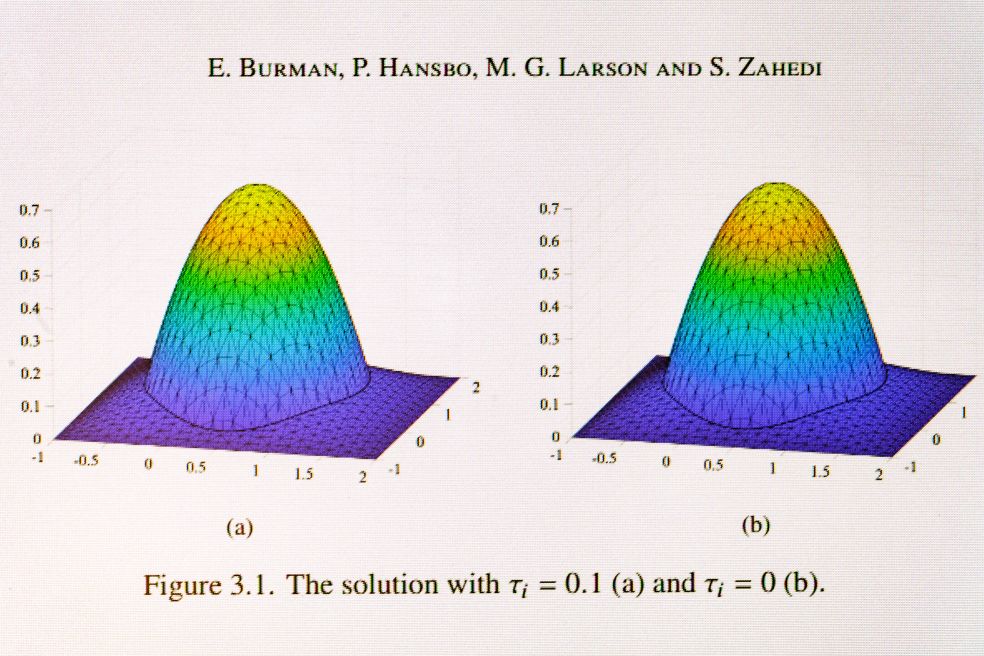
A computational method Zahedi uses to solve differential equations is the Finite Element Method (FEM), in which a computational domain is divided into a mesh consisting of many smaller elements.
But FEM has its limitations. When the geometry changes significantly, the computational mesh must be adapted to the new geometry, which can be both difficult and computationally demanding.
She therefore developed the Cut Finite Element Method – CutFEM. This has enabled Zahedi and her colleagues to study how fluids and cells move and change shape without having to continuously update the mesh in the computer simulation.
The grant from Knut and Alice Wallenberg Foundation enables me to explore boldly and take risks, and I am very grateful for that.
Within the scope of the Wallenberg Academy Fellow grant, she has been able to further develop CutFEM and make the method more accurate.
“We can now use CutFEM to simulate complex and moving geometries without having to adapt the computational mesh to the geometry, while still maintaining the accuracy and robustness of the method. We’ve recently refined CutFEM further to preserve important physical properties such as mass and incompressibility.”
Efficient simulation
Zahedi sees a clear societal benefit in computer simulations increasingly replacing traditional experiments, not least in the development of new medicines. She is inspired by the challenge of handling large numbers of moving objects and particles.
To advance work on computational models for many moving shapes, she has studied microbubbles that can pass through the blood–brain barrier and deliver medicines to specific areas of the body. These applications use a very large number of microbubbles simultaneously.
She and her research team are developing “surrogate models.” Instead of simulating an entire system at once, the researchers study how a single particle affects the flow. The results are then combined to estimate the effect of thousands of particles.
“This type of simulation is very cost-effective. The goal is to be able to perform accurate computations on an ordinary laptop. I should also mention that we continuously use CutFEM to validate and improve the surrogate models,” says Zahedi.
3D surrogate model
She is now continuing her work by incorporating machine learning into the surrogate models so they can cope with geometries other than circular shapes. The next step will be to develop a 3D surrogate model that can also deal with deformable geometries.
“I always strive to find solutions or methods that can be general and useful in many different contexts.”
Zahedi stresses that this type of research requires good conditions.
“The grant from Knut and Alice Wallenberg Foundation enables me to explore boldly and take risks, and I am very grateful for that.”
Text: Ylva Carlsson
Translation: Maxwell Arding
Photo: Magnus Bergström