A tiny parasite causes disease in around 280 million people every year, yet much of its biology still remains a mystery. Researcher Ellen Bushell is studying the malaria parasite at the molecular level to identify the genes that play a crucial role in the infection process. She is mapping the parasite’s innermost functions to find its weaknesses, and hopefully, contribute to future treatments.
Ellen Bushell
PhD in Molecular Infection Biology
Wallenberg Academy Fellow, extension grant 2024
Institution:
Umeå University
Research field:
Molecular studies of the malaria parasite
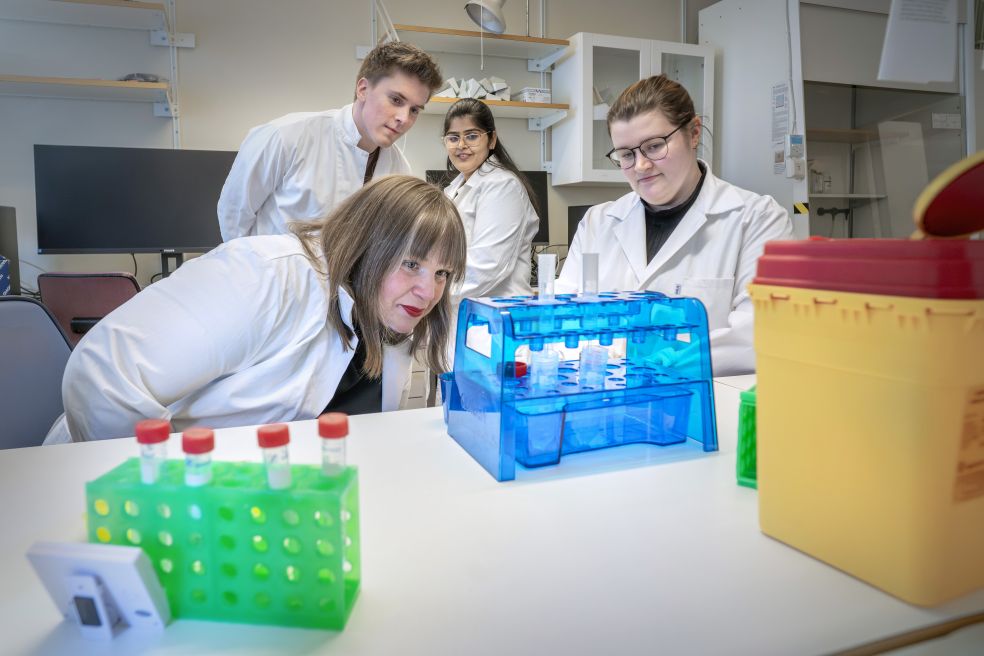
Bushell heads a research team at Umeå University that is studying the most fundamental functions of the malaria parasite. Their research operates at the molecular level, focusing on what actually happens inside the body when the infection takes hold.
“We are trying to understand what the parasite’s genes do. To do so, we are developing and using genetic tools that enable us to inactivate numerous genes at once to see which ones are necessary for the parasite to grow and cause disease,” says Bushell.
Malaria is caused by parasites of the Plasmodium genus, which carry around 5,000 genes. Despite decades of research, many of them are still poorly characterized. Bushell’s research is intended to gradually fill in those gaps.
Potentially severe disease
A critical stage is when the parasite infects red blood cells. That is when symptoms occur – including the cyclical fever characteristic of malaria, which comes and goes and can also lead to anemia. In severe cases, life-threatening complications can occur. But what happens at the cellular level is far more complex than the symptoms suggest.
“The parasite takes over the blood cell and remodels it. It creates its own system of proteins and membranes that enable it to survive, take up nutrients and protect itself. This is quite a radical transformation of a cell that is otherwise very simple.”
The infected blood cell becomes misshapen and stiff and not only changes internally;its surface is also affected, making the cell sticky. This causes it to become lodged in the body’s smallest blood vessels, with important consequences. One is that infected red blood cells are protected and cannot effectively be cleared by the spleen. This process is called organ sequestration and also drives severe disease, since the parasite can attach to the brain, lungs, and placenta in pregnant women, for example.
“These are precisely the mechanisms we are trying to understand in detail,” says Bushell.
To do so, the research team is using a special mouse model of malaria. This enables them to manipulate the genes of the parasite in ways that are not possible in studies of human malaria, and also to analyze many genes in parallel.
“This allows us to work more systematically. We can identify the genes that are crucial for the parasite’s ability to cause disease.”
The research is curiosity-driven, but with an eye on future therapies. Understanding the functions the parasite depends on will enable the researchers to find its weaknesses.
“I usually describe it as a puzzle. We contribute pieces that combine with the research findings of others to build a larger whole. You don’t always know which piece will be important, but every new insight matters.”
It feels important to contribute to the fight against one of the world’s most widespread infectious diseases, which causes immense suffering and claims over half a million lives every year.
Love at first sight
Bushell’s interest in the malaria parasite arose early. During her master’s studies at Imperial College London, she was able to study the parasite under a microscope for the first time.
“I was lucky enough to spend time in the lab of an incredibly influential and inspiring researcher, Bob Sinden. When I first saw a stage of the malaria parasite under the microscope, where many parasites were tightly packed in cysts, it was love at first sight. That was over twenty years ago, but I’m still as surprised and fascinated by how such a tiny parasite can have such advanced and exciting biology.”
Daily life in the research team consists of a mixture of long-term projects and detailed laboratory work. Experiments are planned, carried out and analyzed, the result often being small steps forward.
“Much of our work is about patience. Big breakthroughs are rare, but a gradual understanding develops over time.”
Collaboration is a central feature of the project. The research is being conducted in close contact with other groups in Sweden and abroad.
“It’s a collective effort. No one does everything alone, but together we’re building knowledge to advance the field.”
But there is also clearly a broader context. Malaria remains one of the world’s most widespread infectious diseases, and its growing resistance to existing drugs means there is an urgent need for new knowledge.
“Contributing to the understanding of a disease that causes so much suffering is a huge motivation.”
An extension grant from the Wallenberg Academy Fellows program provides the opportunity to adopt a more long-term approach and further develop the research.
“This type of grant allows me to take on larger challenges and build on what we have already done. It plays a vital role in driving the research forward.”
Despite the big questions, small discoveries are often what maintains research momentum – a gene that turns out to be important, a mechanism that becomes clearer.
“That’s what makes research so enjoyable – constantly understanding something a little better than before.”
With continued focus on the most fundamental functions of the malaria parasite, the work now continues – step by step, gene by gene – toward a deeper understanding of one of the world’s most problematic diseases.
“It feels important to contribute to the fight against one of the world’s most widespread infectious diseases, which claims over half a million lives every year.”
Text Elin Olsson
Translation Maxwell Arding
Photo Johan Gunséus