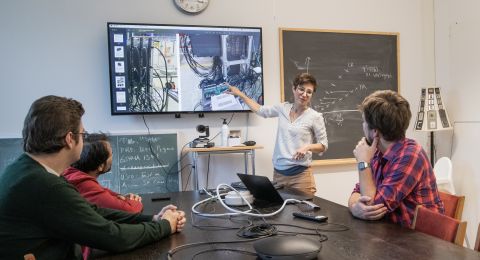
Using ultrashort and enormously powerful light pulses, atoms can be ionized, triggering quantum-mechanical phenomena. Marcus Dahlström at Lund University is designing models to explain what happens:
Marcus Dahlström
Associate Professor of Mathematical Physics
Wallenberg Academy Fellow, extension grant 2024
Institution:
Lund University
Research field:
Strong-field laser physics, quantum optics, photoionization
“If you are precise enough, you reach the next level of understanding.”
Photoionization occurs when light strikes an atom with such high energy that one or more electrons are detached and the atom becomes ionized. Dahlström, who is a Wallenberg Academy Fellow, researches photoionization and quantum-mechanical phenomena. For many years now, he has specialized in attosecond physics, a field in which researchers study the movements of electrons using laser pulses as short as an attosecond – one billionth of a billionth of a second. He and his colleagues have used these pulses to study the measurement of time in extremely rapid processes.
“I’m now concentrating more and more on another type of laser beam – the free-electron laser. Here, a completely different kind of physics applies, which I find exciting. The beams are so strong that you create a mixture of light and matter; you have to describe the electron as something that cannot be distinguished from the light,” says Dahlström.
The most powerful light pulses that can be created
Describing and understanding these processes is precisely his role as a theorist. He laid the foundation for his current work in several locations: in Lund, in Stockholm, and as a visiting researcher in Hamburg at the Center for Free-Electron Laser Science (CFEL).
“Attosecond pulses demand incredible precision of the lasers, but in Hamburg the issue is more that the free-electron laser is so extraordinarily powerful. You create the most powerful pulses you can and see what happens. It’s insanely cool, actually,” says Dahlström, chuckling.
These experiments create completely new, unexplored physics. Bombarding an atom with a pulse powerful enough to dislodge twenty or thirty electrons produces an unusually strongly charged ion. The electrons that remain around it then begin to move even faster than usual, close to the speed of light, triggering relativistic quantum-mechanical phenomena.
A new way to study entanglement
One phenomenon that Dahlström is studying is known as quantum entanglement. This refers to the relationship between the ion and the electron that has been dislodged. Entangled particles have a kind of quantum-physical connection between them, so that the state of one can affect the other, even though they are in different places. The phenomenon has been known for a long time, but two aspects are special in this case. First, the entanglement is created by the pulse that researchers send out, which means that it can be carefully controlled. Second, the remaining ion can also decay and emit light on its own, which impacts the entanglement. It shifts from involving only the ion and the electron to involving the light as well, and in the next step only the light and the electron are entangled.
Many quantum-mechanical investigations concern only individual atoms. I want to study what happens when multiple atoms are involved.
“This is absolutely fundamental. That transition has not been studied before, and it opens up opportunities to study many other things,” says Dahlström.
There is currently great interest in future quantum technologies, such as quantum sensors and quantum computers. But Dahlström is conducting basic research aimed at understanding and describing the world.
“You need to have a sufficiently effective model. The trick is to make it sophisticated enough to describe what is happening – without including any additional complications. If you are precise enough, you reach the next level of understanding. Then you can build on that model, and you begin to see changes that the model can’t explain, so you carry on building...”
He uses quantum calculations and models in an attempt to explain experimental data, but he also wants to stay one step ahead of the experimentalists and suggest investigations they could carry out.
“I think I’m a little more practically minded than many theorists, and my team is quite flexible and creative when it comes to thinking up experimental proposals.”
The importance of creativity
Dahlström’s parents are academics but not researchers. As a child, he wanted to become an animator, but he found most things enjoyable – music, drawing, learning things. When he enrolled at Lund University, he chose engineering physics because he was told that “if you do that, you can become whatever you want.” Meetings with inspiring colleagues in several countries helped him gradually to find his way to what he does today. One such meeting occurred when he was studying for his master’s degree. He took a course in light-matter interaction led by the Lund researcher and now Nobel laureate Anne L’Huillier. It was so exciting that he felt he had to continue studying it.
“To be a researcher, you have to be absolutely sure that it’s what you want to do, because there are so many gifted researchers. I feel I can hold my own because of my creative qualities. I think you have to have an idea about an interpretation, something that goes beyond the complex calculations. That’s where I can contribute.”
Text Lisa Kirsebom
Translation Maxwell Arding
Photo Åsa Wallin