A new form of matter, based on electrons condensing in groups of four, appears to possess new and unexpected properties. Egor Babaev and his research team are mapping the new properties of this super-matter.
Project Grant 2024
Emerging Frontiers: unraveling the properties of the new state of matter: electron quadrupling condensates
Principal Investigator:
Egor Babaev, Professor of Theoretical Physics
Co-investigators:
KTH Royal Institute of Technology
Yunxiang Liao
Johan Carlström
Stockholm University
Vladimir Krasnov
Andreas Rydh
Host Institution:
KTH Royal Institute of Technology
Grant:
SEK 26 million over five years
Matter can exist in solid, liquid or gaseous form. In physics these are known as states of matter. For instance, whether water appears as ice, liquid or steam depends on how quanta and electrons flow and arrange themselves in atoms and molecules.
Ever since antiquity, determining the states of matter that are possible has been a central question in physics. We now know there are more states of matter than the three classical ones above. Materials that are cooled to ultralow temperatures can enter a state that conducts electricity without resistance, a property that gave the world superconductors.
A new theory was introduced in 1957. Known as the Bardeen-Cooper-Schrieffer (BCS) theory, it states that superconductivity arises when electrons form pairs. These act as a collective condensate – a state of matter in which pairs of electrons flow together allowing electric flow without friction. The electrons, when forming pairs lose some of their individual behavior and instead collectively follow the rules of the quantum world in a coherent way, causing the matter to acquire new properties.
Considered impossible
For almost half a century after the BCS theory was presented, the prevailing view among the world’s physicists was that electrons could only bind in pairs.
But in 2002, Babaev, then a newly graduated doctoral student in theoretical physics at Uppsala University, predicted that, in theory at any rate, electrons could coordinate themselves in groups of four – quadruplets – in certain circumstances. He had been trying for several years to publish an article setting out his results. The article was finally accepted for publication in 2004.
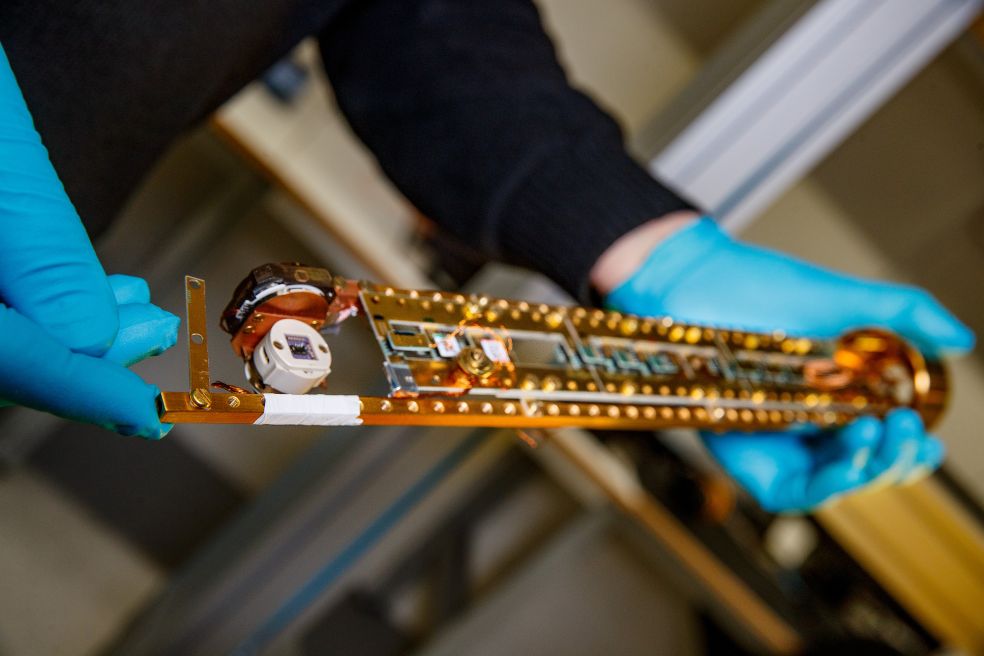
It would take another twenty years, however, before Babaev, working with researchers Vadim Grinenko, Andreas Rydh, and others, managed to show that quadruplets exist, using physical experiments. The breakthrough was presented in Nature Physics in 2021.
“It was fantastic, the first experiments revealed physical properties, considered impossible, the leading experimentalist even took samples to repeat measurements at a different University, first experimental results were reported at a conference in Stockholm in 2018 but then were repeated multiple time before publication of the paper in 2021” he recalls, who now is a professor of theoretical physics at KTH Royal Institute of Technology in Stockholm.
The quadruplets, like Cooper pairs, form a condensate. The matter thus exists in a completely new form whose properties remain largely unexplored.
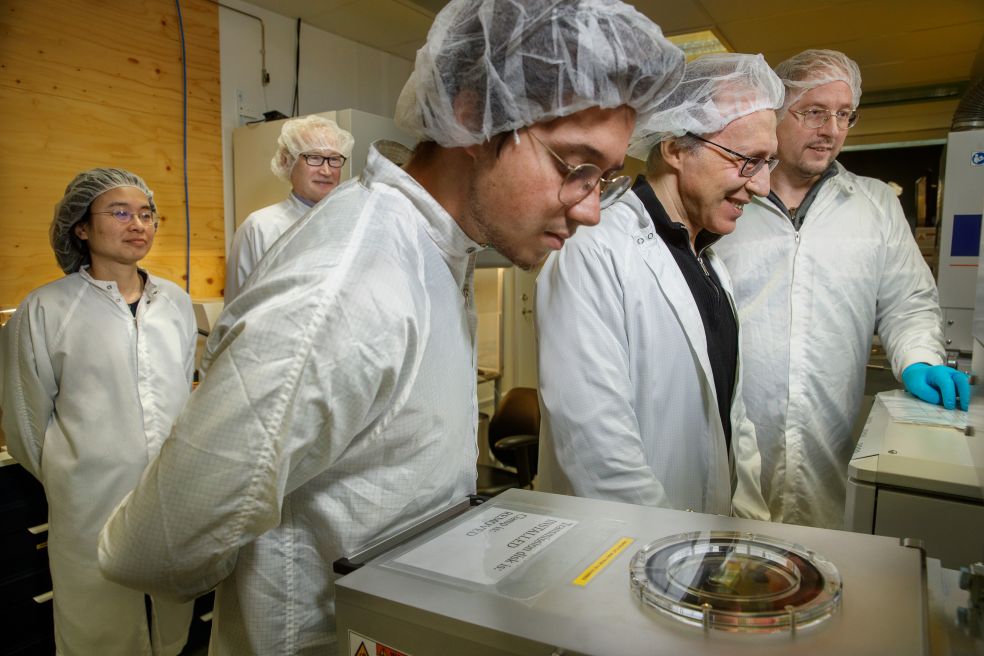
Here, in the AlbaNova building, he heads a small research team of theorists and experimentalists, who are mapping in detail the properties of the newly discovered state in a five-year project funded by Knut and Alice Wallenberg Foundation.
Different from superconductors
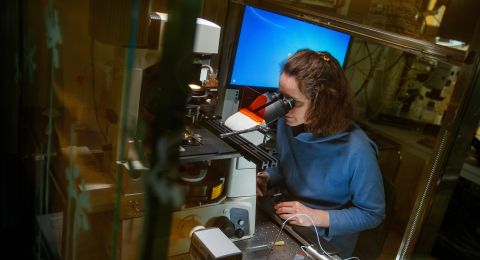
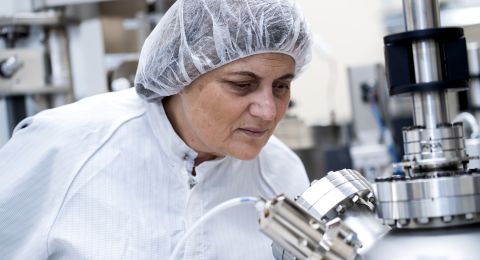
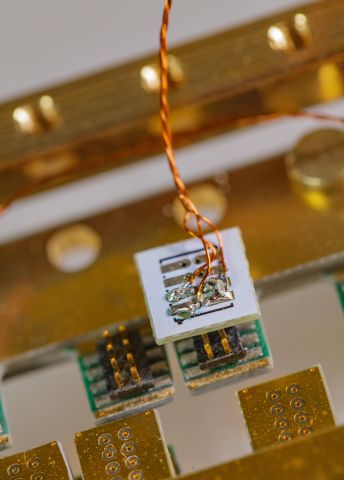
The new state of matter is investigated in a clean room, where they use a cryostat to lower the temperature of an Iron-based material that is doped with Potassium. The new phenomenon occurs when the particles are cooled to very low temperature.
So far, the researchers have seen that it can produce spontaneous magnetic fields. In contrast to superconductors, the state retains its resistance when one tries to pass current from side to side. This means that the new state differs principally from the state that produces superconductivity.
“Super-states-of-matter” is used to describe new states of matter that lack resistance or viscosity beyond the three classical states: solid, liquid and gas, which in turn can be categorized as superconductors, superfluids, superfluid-vapors and supersolid matter.
The team at KTH is studying the iron-based super-matter in the hope of revealing many new and unexpected properties. Babaev elaborates:
“The measurements we have made so far show that the matter may have properties not previously recorded.”
If these early findings are correct, the researchers hope the new properties will eventually be useful in sensors or quantum computers, for example.
Can higher orders exist?
So far, the researchers at KTH have only succeeded in creating one new state, the iron-based one. But they are also examining whether it is possible to use other metallic materials to create similar unknown states of matter. In principle, it ought to be possible, explains Babaev:
“We already have some evidence that other materials can be used for the same purpose. What we uncover is not just a new state of matter, but a whole new family of states of matter”
Another major question for the team is whether a state of matter based on binding numbers higher than four also exists, i.e., in addition to quadruplets. Could there be sextets of electrons in the ghost-like and wondrous world of matter?
"Yes, in 2010 we theoretically predicted higher-order condensates of sextets and even octets. Furthermore, there were many follow-ups on these ideas by others, often called composite or vestigial order." says Babaev. “In China there is a currently experimental pursuit of condensate of sextets."
Text Monica Kleja
Translation Maxwell Arding
Photo Magnus Bergström