There is a pressing need for more accurate climate models to be able to predict future climate change. Ilona Riipinen is taking a new step toward refining climate models based on observations and experiments from recent decades.
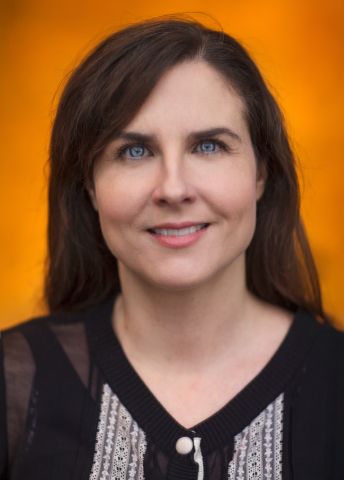
Ilona Riipinen
Professor of Atmospheric Science
Wallenberg Scholar
Institution:
Stockholm University
Research field:
Atmospheric aerosol particles and the role they play in cloud formation and climate
Riipenen, who is a Wallenberg Scholar, has gathered her research team around the task of coordinating more than twenty years of research on the atmosphere. She has been conducting research in atmospheric science at Stockholm University since 2011. In 2017 she became one of the university’s youngest professors.
“We have built cutting-edge expertise over the past 20 years – always with the goal of improving current climate models and the regional models that measure air quality,” says Riipinen, professor of atmospheric science.
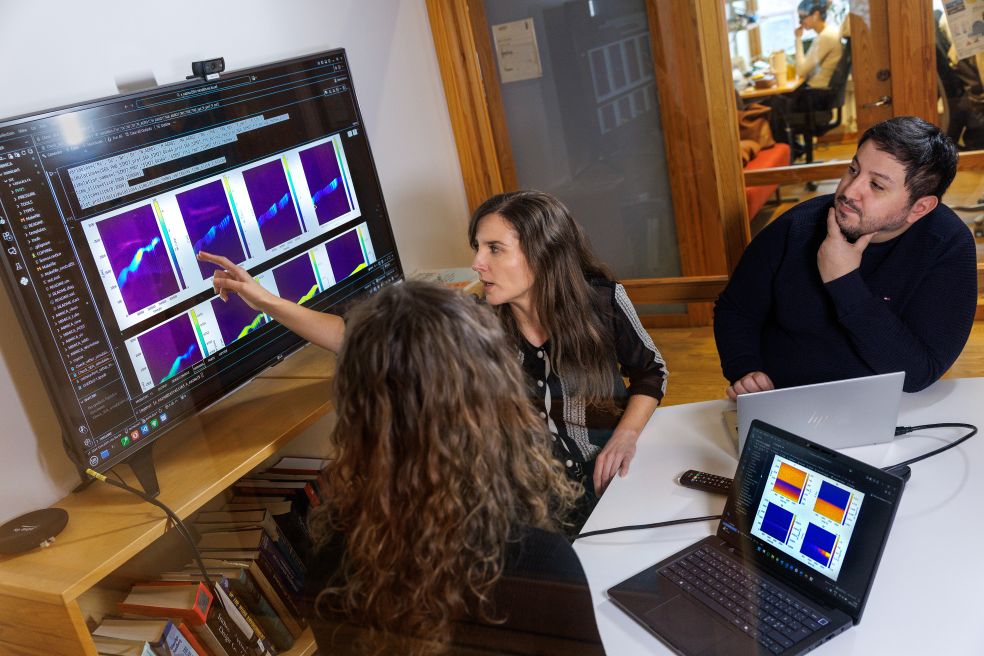
She and her team are updating current climate models so they better describe how clouds, precipitation and particles affect the planet’s future.
Atmosphere full of activity
The atmosphere is the thin but life-sustaining layer of gases and particles that surrounds the Earth. Numerous chemical and physical processes take place in the gas layers, impacting everything from energy balance and climate to air quality.
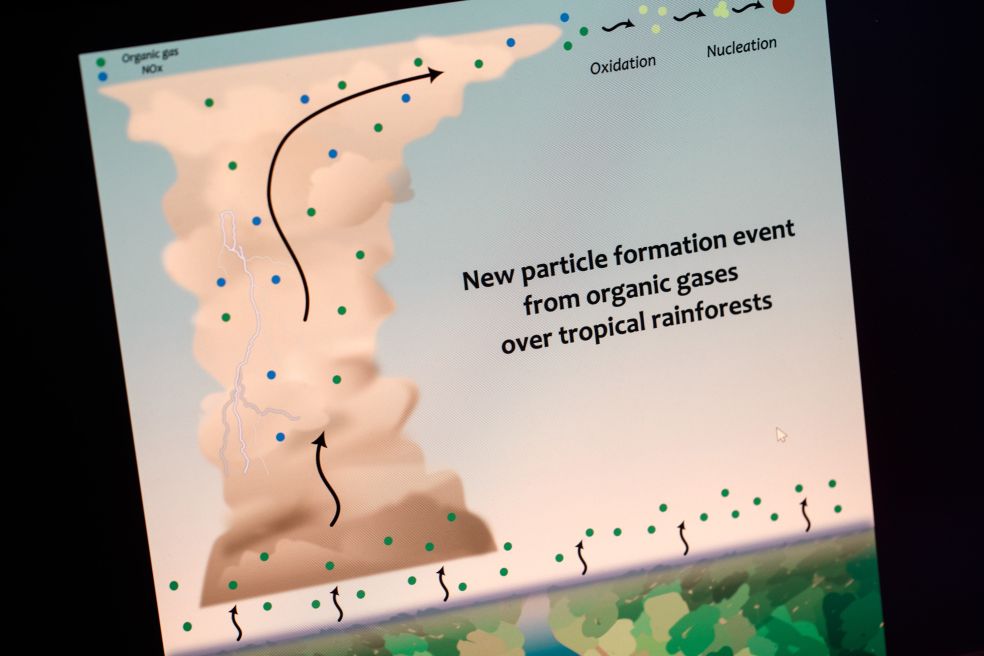
Particularly important are the minute particles, aerosol particles, which contribute to cloud and ice formation in the atmosphere.
“When we talk about atmospheric aerosol particles and cloud formation, we often stress how complicated it is – it’s a very challenging field. Our goal is therefore to collate and simplify the knowledge we have about phase transitions in the atmosphere into useful numerical models.”
Even though the knowledge is simplified, she emphasizes that the research team is very keen not to lose scientific accuracy.
But there are numerous difficulties, not least the challenge of mathematically taking into account the differences between particles and gases of various kinds. The particles vary in size, reflect radiation to varying degrees, and also differ chemically. Gas molecules also vary in size and move in individual ways through the layers of the atmosphere.
“In principle, we ought to take all of this complexity into account. But that is not possible, so it’s important to be able to simplify the process in order to describe it numerically and mathematically. It’s an intellectually very exciting task,” she says.
Bringing fields together
The project brings together knowledge and researchers from different fields. This includes the very detailed knowledge that exists about molecular processes in the atmosphere, along with the researchers engaged in developing climate models. During 2019–2024, Riipinen led an EU-funded project called FORCeS, which in part laid the foundation for bringing these fields together.
If we manage to crack the problem of how aerosols affect cloud formation and precipitation, then I will be satisfied – and it’s not an unrealistic task.
“My roots in physics and chemical engineering have given me an understanding of the detailed molecular processes. And during my time at Stockholm University I have learned more about the broader context of climate models. Now I am ready to tie these elements together,” she says.
The goal is for climate models not only to become better at predicting a rise in temperature, but also to show why the increase occurs based on causal chains that researchers have identified in nature.
“Among other things, we hope to be better able to predict how much warming we can expect with a given increase in carbon dioxide concentration and how that impacts the water cycle. This would improve our understanding of climate sensitivity and enable us to better predict changes in precipitation patterns, for example.”
Measurement data important
The research team is using a combination of advanced numerical models and long dataset series from research stations around the world. When Riipinen shows us around the Department of Environmental Science, we have to weave between large wooden shipping crates. They are filled with measuring instruments that are transported to locations around the world to collect data. Field studies in places as diverse as the Amazon rain forest, Svalbard and Italy have enabled the researchers to continue building their knowledge.
“It’s impossible to have a perfect control experiment for our research – we only have one planet. But the models we create can be used as control experiments, and it’s vital they be based on as long time series as possible.”
The field studies are linked with experiments in laboratory environments, for example in the cloud chamber at CERN. There, researchers have been able to study closely how the very smallest particles are formed. Moving from the smallest particles to understanding the impact of the atmosphere on the entire Earth is a challenge she enjoys.
Ever since Riipinen came to Sweden from her home country of Finland, she has received support in various forms from Knut and Alice Wallenberg Foundation.
“It has naturally been extremely important to receive such long-term support. The freedom it has given me has meant a great deal for the quality of my research. And the networks made available to me have meant a lot for someone who did not grow up in Sweden.”
Choosing the field of atmospheric science was a result of the research that was being conducted at her department at the University of Helsinki. Now she is ready to look back and summarize more than two decades of research – something that will doubtless give rise to new questions to explore.
“As a researcher, it is important to be open to change, to be curious and to have a strong desire to learn new things. I love the feeling you get when you realize you were wrong and can then look at something with new eyes.”
Text Magnus Trogen Pahlén
Translation Maxwell Arding
Photo Magnus Bergström