We still know very little about how energy flows within our cells. Wallenberg Scholar Ville Kaila is using advanced methods to understand how a complex protein chain keeps the flow running. This knowledge may contribute to new treatments for severe genetic and neurodegenerative diseases.
Ville Kaila
Professor of Biochemistry
Wallenberg Scholar
Institution:
Stockholm University
Research field:
Molecular mechanisms of enzyme catalysis with a focus on biological energy conversion systems
Within our cells, there is an organelle often compared to the cell’s own power plant: the mitochondrion. It has the ability to capture and convert the energy from molecules in the food we eat into electrical energy. This conversion takes place with the help of large protein complexes that absorb and channel the energy required for cell growth and metabolism.
“We’re trying to unravel energy conversion at the molecular level. How are the atoms arranged in these proteins, and how do they change their structure in order to function? Our aim is to map the entire process step by step to see how the proteins depend on each other’s function,” says Kaila, Professor of Biochemistry at Stockholm University.
He has devoted virtually his entire research career to understanding the energy conversion that takes place in the mitochondrion.
“We have now achieved an important understanding of the central mechanisms in this machinery, largely thanks to recent technological advances, for example, in cryo-electron microscopy. Although this is basic research, we also see exciting biomedical applications ahead,” he says.
Modeling with proteins
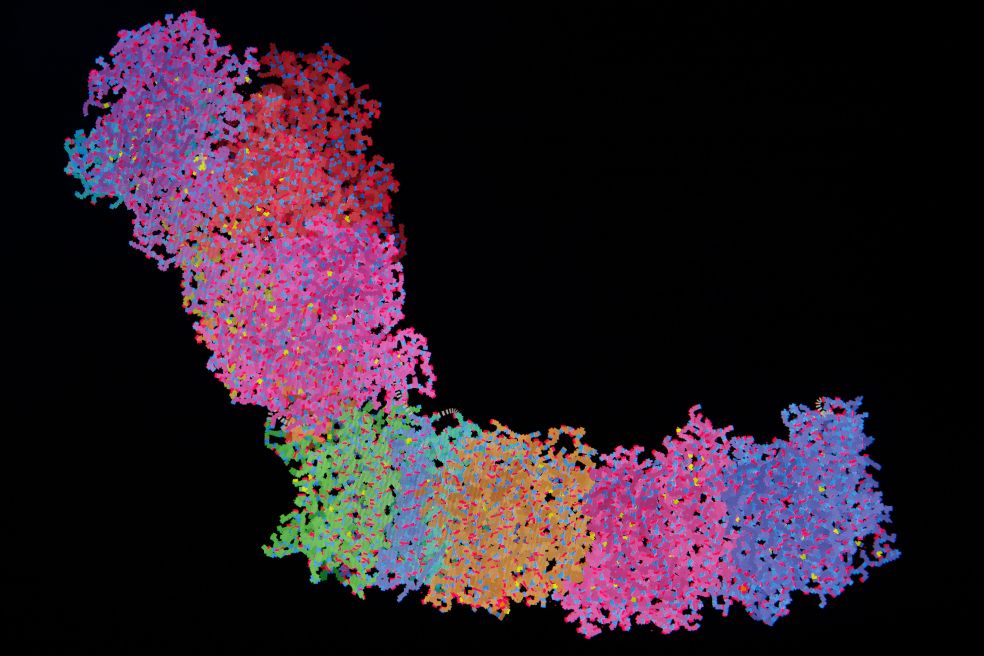
Cryo-electron microscopy enables researchers to image the three-dimensional structures of molecules. These images can then be used to create models showing the positions of atoms within the molecules. The structures of the energy-converting proteins have proven to be extraordinarily complex, which is also reflected in their function.
“We have managed to take apart some of the proteins, and cryogenic techniques enable us to gain a better understanding of their function. We then modify the different components on the basis of advanced computational models and examine them, gradually learning more as we do so.”
The proteins are embedded in the inner membrane of the mitochondrion and form a complex respiratory chain. The chain itself forms a highly efficient electrical circuit in which electrons and protons flow. The membrane works as a kind of battery.
“Although we are studying biological materials, my approach is more like that of a physicist than a medical researcher. When we study energy flow, we look for components with functions similar to those in electronics. We find biological transistors, insulators and diodes,” he says.
For example, water molecules have proven to be an important component of the biological circuit, in which water-filled channels control the transport of charges.
As a child, I always used to take my toys apart to see what they looked like and how they worked. We’re using the same approach to understand energy conversion in nature.
Tracing the origins of life
The proteins employ quantum-mechanical phenomena to impel charges through the chain. This essentially involves the quantum tunneling effects highlighted in the award of the 2025 Nobel Prize in Physics.
“The connection to quantum mechanics is very exciting. And nature uses the same basic principles to harness the energy of light by exploiting different functions of the protein building blocks. This raises fundamental questions, the answers to which can tell us more about the origins of life,” says Kaila.
One line of his research aims to understand nature’s photosynthetic processes. These exploit an interaction between light and matter that leads to energy conversion resembling that in the mitochondrion. However, the end products can be entirely different from those in the human cell, e.g., oxygen in cyanobacteria or hydrogen in other bacteria.
“When we understand the fundamental principles underlying energy conversion, we can use them to create entirely new functions – including even ones that do not exist in nature. This could involve new applications in biomedicine, sustainable energy technology or synthetic biology.”
Curing genetic diseases
In biomedicine, these advances could lead to new treatments for severe diseases. If any of the proteins in the respiratory chain are affected by a mutation, severe genetic disorders may result. There is currently no cure and very few treatment options for mitochondrial diseases.
“We have recently initiated collaborations with medical researchers. Connecting physical principles with medical questions is a very exciting step.”
Kaila’s strong fascination for natural science began way back in upper secondary school, when he realized that biology, physics and chemistry are all interconnected. Before choosing to train as a biochemist, however, he studied classical violin at the prestigious Sibelius Academy in Helsinki. He still plays and also performs together with other musicians, often in scientific contexts. He sees clear similarities between scientific research and creating music.
“The approach is very similar: an idea provides inspiration, which then provides the impetus to realize the work. Also, many phenomena in science are both elegant and beautiful. They contain their own kind of aesthetic, in much the same way as music,” he says.
Text Magnus Trogen Pahlén
Translation Maxwell Arding
Photo Magnus Bergström