Wallenberg Academy Fellow Klas Modin wants to use mathematics to understand nature’s chaotic structures. To succeed, he is combining quantum theory with equations dating back almost 300 years. In this way, he is taking important steps in fundamental mathematical research, which could ultimately have a bearing on everything from plasma physics to our understanding of hurricanes and astronomical phenomena.
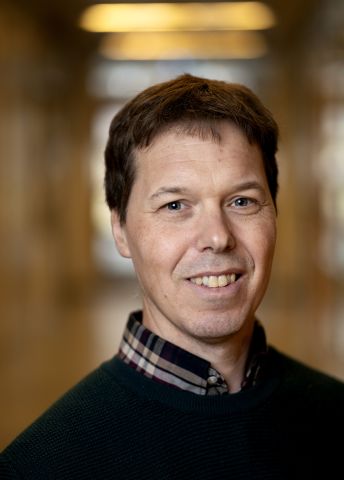
Klas Modin
Professor of Mathematics
Wallenberg Academy Fellow, extension grant 2024
Institution:
Chalmers University of Technology
Research field:
Geometric hydrodynamics
It is possible to describe mathematics as calculation, but Modin sees the true magic of the subject in an entirely different way. For him, mathematics offers an opportunity to understand structures and gain a more profound understanding of phenomena in our world.
“Nature seems to be organized in a certain way. It’s fascinating to see how certain structures and phenomena recur in many places and can appear in a multitude of different forms. Mathematics is a fantastic tool for describing nature, and it often works surprisingly well,” he says.
Modin’s primary focus is on fluid equations. These describe how fluids, such as masses of water or air, move through time and space. The motion is chaotic, but there are mathematical patterns within the chaos—and it is precisely those patterns that he wants to capture.
One of his goals is a better mathematical theory for the phenomenon of turbulence, which occurs when gases or liquids flow in a disorderly and irregular way. During turbulence, vortices and rapid changes in pressure and velocity occur. The same phenomenon occurs over multiple scales, from hurricanes to the movement when you stir your coffee.
From describing weather to plasma physics
Although Modin’s focus is on fundamental research, there are many future applications in sight if turbulence can be better understood and described mathematically. This is particularly true in the field of atmospheric dynamics, which studies the mechanisms behind weather and climate.
“Hopefully, my research can contribute to better tools for calculating weather phenomena, such as the movement of storms and vortex mixing, as it is known: how storms merge in extremely complicated patterns and form hurricanes. The research could also help explain atmospheric phenomena on other planets, such as the Great Red Spot on Jupiter—a gigantic storm that has lasted for at least 300 years, but probably much, much longer,” he says.
Plasma physics is another area where Modin’s work may be of importance. Over the past year, he has used his approach to understand phenomena in plasma physics, which play a key role in the development of the highly sought-after fusion reactors of the future for clean and almost unlimited energy.
“This is what is so magical about mathematics: because it focuses on structures and not on individual applications, the same mathematics can be applied to vastly different fields,” he says.
Eighteenth-century equations meet modern quantum theory
The fluid equations that lie at the center of Modin’s work are almost 300 years old. Yet those equations, formulated in 1757 by a mathematician called Leonhard Euler, are still the central mechanism for describing phenomena such as weather systems. But they do pose major challenges for researchers.
I’m extremely curious about mathematics and what it can say about the world.
“There is still much we don’t understand about Euler’s equations. They are nonlinear equations where the solutions cannot be written down as a formula. Instead, we must find other ways to understand and use the solutions,” he says.
His research team is using an unexpected and unusual approach to tackle the problem. They are combining older equations with modern quantum theory. The researchers can use quantum theory to formulate important parts of Euler’s equations using matrices, a kind of tabular system. It then becomes possible to approach the answers.
“Numerical tables can be processed efficiently by computers, giving us a tool for calculating solutions. It’s still a matter of approximation, rather than being able to establish exact solutions. But we can come one step closer to understanding how different solutions behave in different situations,” he says.
Curiosity led to academia
Modin has always been interested in technology and physics. As a child, he enjoyed putting things together and trying to make them work—whether building with LEGO or writing his own computer programs. His father was a marine biologist, so he came into contact with the world of research at an early age.
“I remember the time my father bought a popular science magazine and told me about quarks in particle physics—the building blocks of matter. I was absolutely fascinated. Perhaps that was the starting point that led me to become a researcher,” he says.
He describes being a researcher as a tremendous freedom, but with an enormous responsibility.
“Research can be tough, especially during the first years before securing a permanent position. But when I was doing my PhD, I realized that I truly wanted to remain in academia. I’m extremely curious about mathematics and what it can say about the world. I would say that my greatest hobby is my work,” he says.
Text: Ulrika Ernström
Translation: Maxwell Arding
Photo: Johan Wingborg