Group theory has its roots in the early nineteenth century, and is now used in all branches of mathematics. One of the people to discover the notion of “group” to organize objects in algebra and geometry was a young French mathematician called Évariste Galois, (1811–1832). Since then, other prominent mathematicians have built further upon his theory of groups.
Wushi Goldring is one of those following in the Frenchman’s footsteps. He is a Wallenberg Academy Fellow at Stockholm University, where he conducts research and teaches mathematics, specializing in new applications of group theory.
Galois demonstrated that organizing and classifying objects by groups was a rich source of new mathematics. He himself laid the foundations for both abstract algebra and algebraic geometry.
Abstract thinking
Algebra is a branch of mathematics using abstract reasoning. It studies equations and symmetries, using variables, instead of merely working with numbers and the four basic arithmetic operations.
But unlike elementary school algebra, which uses specific numbers, abstract algebra focuses more on rules, patterns and abstract structures such as groups, rings and fields.
Algebraic geometry is a framework to study the geometry hidden under the surface of polynomial equations. These equations are defined by the sum of products of variables – y or x – and a coefficient, that is, a number multiplied by the variable.
Goldring sees group theory as an extremely useful tool for researching algebraic geometry.
“I hope to use groups to discover new objects in geometry.”
Even in his early years, he was curious about shapes. As a child he visited Italy, where he attended school for some months, learning to draw using a ruler and compass.
“I learned how to construct a pentagon and other shapes by drawing lines and circles,” he says.
He grew up in Los Angeles, California, where he started taking classes at UCLA, at the age of 14. He then completed his doctoral dissertation in mathematics in 2011 at Harvard University, in Massachusetts.
A universal language
With an open mind and an intellectually playful approach, he aims to use group theory to explore mathematics and to create a universal language with which to explain it.
In particular, he is studying the symmetries of objects. In this context, symmetries are properties of shapes, figures, numbers and equations that allow them to be reflected, rotated or even moved without fundamentally changing.
Group theory has played a decisive role in the Langlands program from the very beginning, but I believe we have not yet realized that it can play an even greater role.
“Imagine a rectangular piece of paper that you can rotate, turn upside down and move without its rectangular structure changing,” says Goldring, turning over an A4 sheet of paper.
Mapping and classifying the symmetries of different objects leads to new and unexpected classes of groups.
“Studying mathematics through symmetries has been very successful, and when asked why the method should be used, Galois gave a very good fundamental example, determining when polynomial equations are solvable using radicals.”
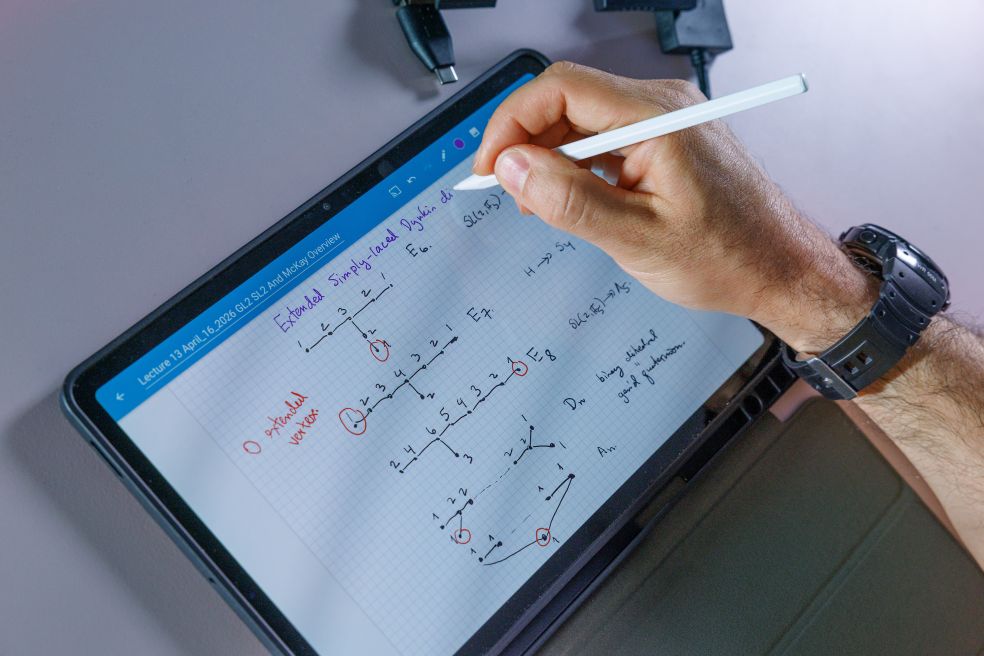
A Galois group consists of symmetries that describe how the roots of a polynomial equation can change places with one another without the algebraic relationships between them changing.
However, Galois wanted to use his theory to unravel the structure of more complicated equations – ones that also involve geometric objects.
Goldring is investigating several directions within group theory, including the new traits that characterize polynomial equations in particular.
Testing earlier research
An additional focus is “G-Zips” – a recently discovered framework for organizing algebro-geometric objects into groups.
The theory of G-Zips is a model that generalizes two things. One is called Hodge theory, which connects polynomial equations and algebraic geometry to analysis
The other is called the Ekedahl–Oort Stratification. A stratification cuts a geometric object into pieces, and uses them and the relations between them to study the object.
In a series of joint papers, Goldring and Jean-Stefan Koskivirta used the G-Zips framework to prove conjectures in the Langlands program. The latter is a deep unification program spanning almost all areas of mathematics as well as some of physics. It consists of a web of conjectures linking number theory and analysis with Galois groups and geometric forms.
“I think this web of conjectures is the greatest discovery in mathematics since Galois,” Goldring says.
He now wants to study the open questions posed by Langlands and other researchers in order to better understand and answer them.”
“From the very beginning, group theory has played a fundamental role in the Langlands program, however I believe that we have yet to discover an even bigger role for group theory. “
There are links between his studies of symmetries and his view of life. Goldring is more interested in the wholeness of existence than in differences, and seeks balance and harmony in nature.
Text: Monica Kleja
Translation: Maxwell Arding
Photo: Magnus Bergström