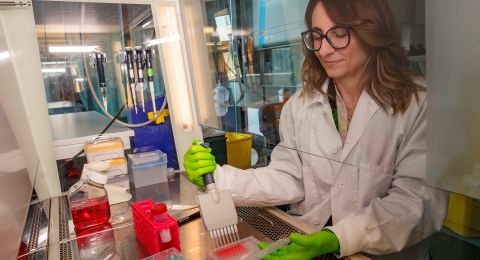
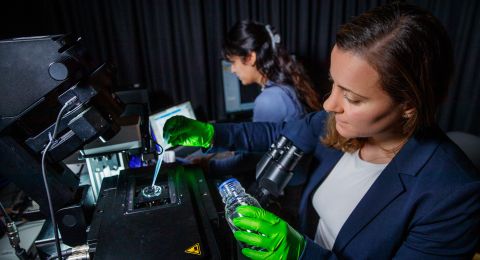
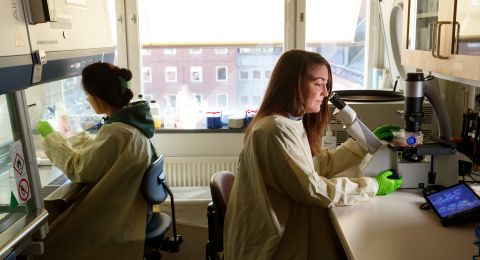
In Alpha Cell, researchers aim to create a virtual cell, a computer model of a human cell with all its molecular components. If they succeed, it could one day be possible to predict and detect disease at such an early stage that the disease process could not only be stopped, but also reversed, returning cells to a healthy state. But there is still a long way to go.
Alpha Cell
Strategic programs
Host organization for the program:
SciLifeLab and KTH Royal Institute of Technology
Grant awarded:
SEK 590 million
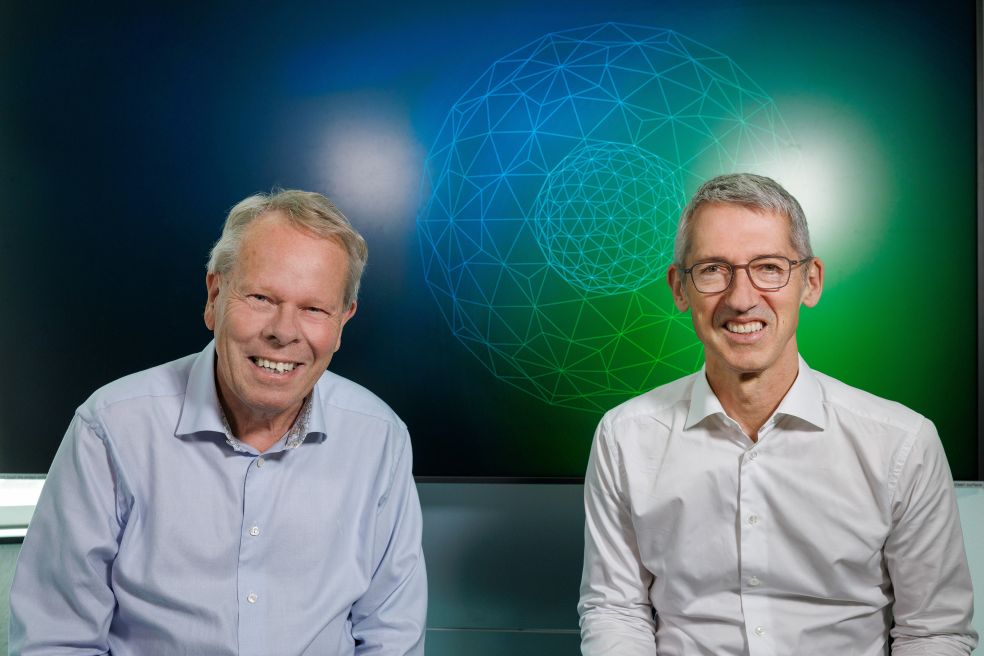
The research program is led by Jan Ellenberg, Professor of Cell Biology and Biophysics and Director of SciLifeLab, and Mathias Uhlén, Professor of Microbiology and Neuroscience and creator of the Human Protein Atlas, HPA.
“It is quite grand in scope, really, but we want to create a virtual model of the smallest unit in the human body – the cells. A model in which we can modulate how the building blocks work together – the very processes that allow us to live,” says Mathias Uhlén.
“It will be like a digital research laboratory, and because it exists in a computer, the work can scale and move very fast,” notes Jan Ellenberg.
In such a model, researchers could run thousands of experiments simultaneously to predict how cells function molecularly and what goes wrong inside them in different diseases. This ability could revolutionize drug development, make precision medicine routine and, further down the line, make it possible to recognize and stop disease progression at such an early stage that it could be reversed.
“Biology has usually worked by producing as much data as possible over many, many decades. And only after that, at some point, extracting knowledge from it. Now in the age of advanced molecular imaging technologies and AI we can truly do both at the same time. It is amazing what can be done. It is a major change.
Complex system
It is thanks to the revolutionary advances in technology and knowledge that have taken place in the life science field — and that can now be further accelerated with the help of large-scale computing power and artificial intelligence — that researchers believe this will become possible.
“I don’t think anyone today has the data sets needed to explain a human cell with all its components. Nor does anyone have the large molecular AI models needed that can be trained with the very large amounts of information required to make mechanistic predictions. So in Alpha Cell, we need to develop both. On the one hand, we must develop AI-based models with an artificial intelligence that can bring together all the molecular information of the human cell, because it is a very complex and highly dynamic system. On the other hand, we must generate in-depth molecular data from inside cells so that we can actually measure directly how many of the many different molecules are there, how they interact with one another, and how those dynamics shift, when the cell’s function changes,” Jan Ellenberg continues.
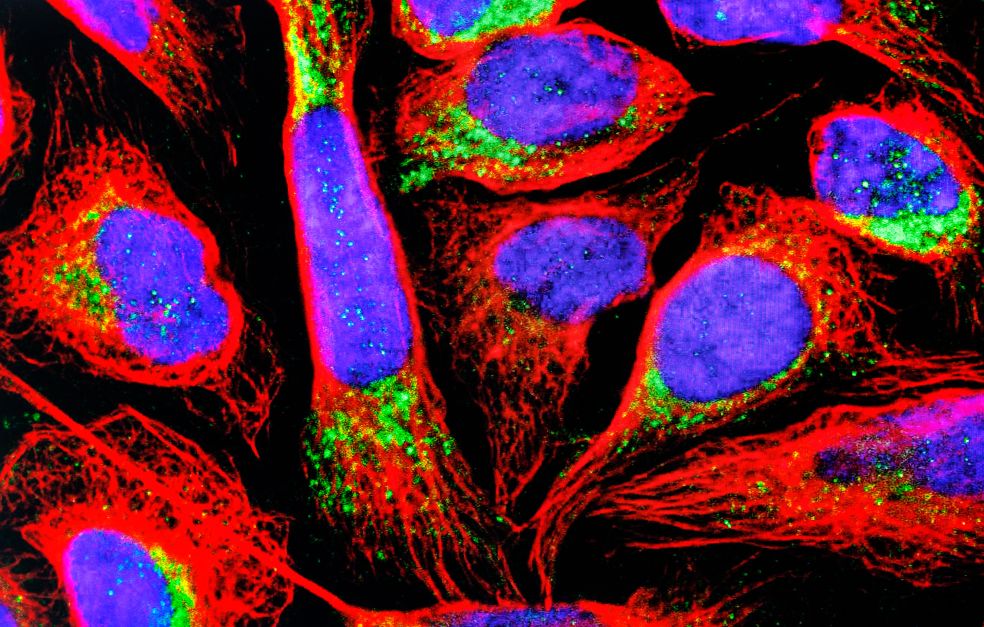
A foundation for the Alpha Cell project is the Human Protein Atlas, HPA, a mapping of the body’s 20,000 proteins with antibodies, collected in an open database. The research project took more than twenty years to complete and was funded by a grant from Knut and Alice Wallenberg Foundation.
“It is one of the largest biological databases in the world. We have tens of millions of images of cells, all annotated, which are completely unique. We will now make all of this AI-ready, as people say, and create a catalog of all the building blocks of the human body. But we also need to generate a lot of new data inside the cell,” says Mathias Uhlén.
“We now have computer algorithms that, for each of these proteins, can predict — based on the genome sequence that encodes them — what three-dimensional shape the protein will have. That is remarkable, but one protein is only one of over 20,000 different parts that make a living cell function by interacting dynamically in a total of many millions of copies and functional variants. The next challenge is therefore to be able to predict such a complex dynamic living system computationally. The first level where we will be able to do that is a single cell,” notes Jan Ellenberg.
To see inside the cell is to understand life
“For a human being, a single cell is a tiny part of the body, because we are composed of trillions of cells in our adult body. But we all started from a single cell, and egg cell after fertilization by the sperm. And that cell divided many, many times to build the wonderful body we have. Each individual cell that makes up our body has functional principles for how it can live, how it can carry out its function that relies on its molecular composition and the dynamic interaction of the molecular parts inside it. Because we now have the tools to map out which parts are inside a single cell and how all the parts interact, we believe that over the next ten years it will become possible to start to predict how a cell functions.”
And that is Alpha Cell’s great vision: to create a virtual cell, a computer model of a human cell with all its molecular components, which can predict what the cell will look like, what its structure is, but also what it will do — in other words, what its function is — with an explanation at the molecular level.
“The molecular level is important, because that is the level at which we have the opportunity to change something in the cell. As molecular biologists, we have the ability to change the code of life — we can change DNA. This means that we can also change which molecules are inside a living system. So, once we understand which molecules give rise to which structure and function, we can actually start to engineer the system and also fix problems when it malfunctions. At the basis of disease, there is in the end a misfunction of a particular cell that no longer is able to fulfill its normal function inside the body.”
“Understanding life at the cellular scale is very fundamental for understanding life at all. This is the first level at which many, many different molecules come together, and the magic of life happens. Nothing smaller than a cell is alive. They are just dead individual molecules,” explains Jan Ellenberg.
Turning back time
Today, disease is usually diagnosed only after many of the molecular processes behind it have already occurred. By then, they are very difficult or impossible to reverse. The cells are already in a completely different state, and it is almost impossible to bring them back. That is why, in diseases such as cancer, the approach is often to kill the cells or remove them surgically, rather than cure the cells themselves. The diseased cells have to, if still possible, be removed.
“That is the beauty of a virtual model. Inside it, you have control over time. In life, time only moves forward. We only get older and we age; we become ill. So once a disease starts to develop, it is a downhill road. In a computer model, you can turn back time. You can bring the cell system back and say: here, it was still healthy. What was it that made it sick? And that also tells us where the first points are at which the system tips from health to disease, and how we can intervene before that happens, while it is still easy to turn the system back.”
To study the molecular structure and their dynamic interactions inside cells, the researchers will, among other things, use and further develop the most powerful microscopes available today.
“We will look inside cells using the most advanced imaging techniques we have today and develop new ones. We need to see individual molecules, see their structure and their function, and how these change over time, because that is the data we will need to create mechanistically predictive models.”
Jan Ellenberg notes that generating the right kind of data on all cellular molecules is still a formidable experimental challenge and building the computer models trained on it is a new quality of AI. To meet these challenges that, the various research groups in the Alpha Cell program will work in a highly collaborative and integrated way.
To succeed, the research program will make a coordinated large investment in data production, AI and computation, recruiting new research groups, while also bringing together the best research in the emerging field of virtual cell biology already present in Sweden. Both the computational groups and the experimental groups will furthermore collaborate with the Foundation’s major program in data-driven life science, DDLS.
Text Carina Dahlberg
Photo Magnus Bergström