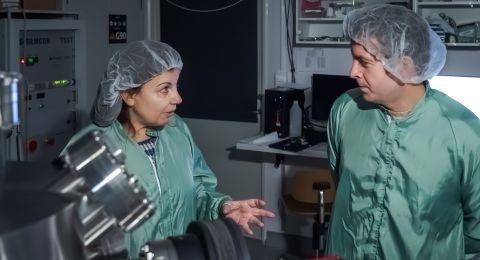
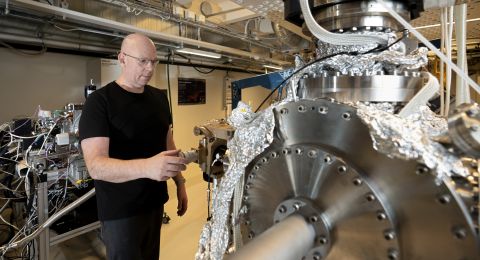
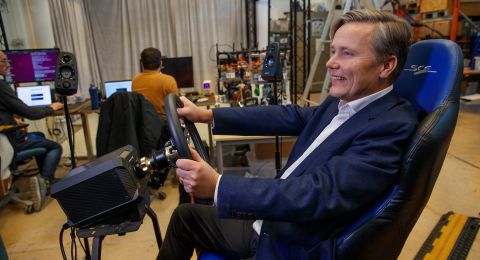
Professor Raimund Feifel and his project team will establish an entirely new experimental station where extremely short laser pulses are used to release electrons from molecules, enabling the researchers to closely monitor the charge redistribution that occurs. Their aim is to understand, and then control, quantum electronic processes.
Project Grant 2024
Attosecond pulse-induced quantum electronic processes
Principal investigator:
Raimund Feifel, Professor of Experimental Atomic and Molecular Physics
Co-investigators:
Lund University
Per Eng-Johnsson
Stockholm University
Eva Lindroth
Umeå University
László Veisz
Uppsala University
Hans Ågren
Institution:
University of Gothenburg
Grant:
SEK 34 million over five years
“We hope the project will be an important step toward this goal, since the ability to control quantum electronic processes would pave the way for new research fields and applications, ranging from materials development to the creation of more compact electronics,” says Feifel.
Albert Einstein was awarded the Nobel Prize in Physics in 1921 for his description of the photoelectric effect, whereby electromagnetic radiation with very short wavelengths can release electrons from atoms and molecules. A hundred years later, Feifel and his colleagues are focusing on the consequences of this effect, of significance for many chemical processes and important in the development of solar cells, sensors and light detectors, among other things.
In the project, which is funded by Knut and Alice Wallenberg Foundation, a group of researchers from the universities of Gothenburg, Stockholm, Lund, Uppsala and Umeå will be attempting to do what no one has so far managed: to study in detail what happens when an electron leaves a quantum system and to monitor the redistribution of molecular charge that then occurs.
“This is a completely new and incredibly exciting field. A long-term dream is to be able to control quantum electronic processes, which would open many new avenues of research. To do so, we need to fully understand and map these processes in real time, and we aim to become world-leading in this respect,” says Feifel, project leader and responsible for assembling the team.
Ultra-short timescales
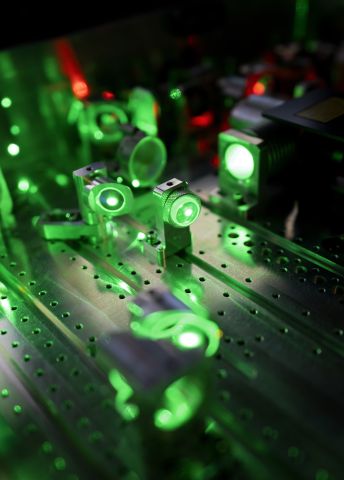
To carry out the experiments, the group is using advanced instruments that enable them to release electrons from the samples using ultra-short laser pulses. The sequences of events studied by the team take place over a few attoseconds, a unit of time so short that it is difficult to comprehend. An attosecond is 10⁻¹⁸ seconds, or one billionth of a billionth of a second.
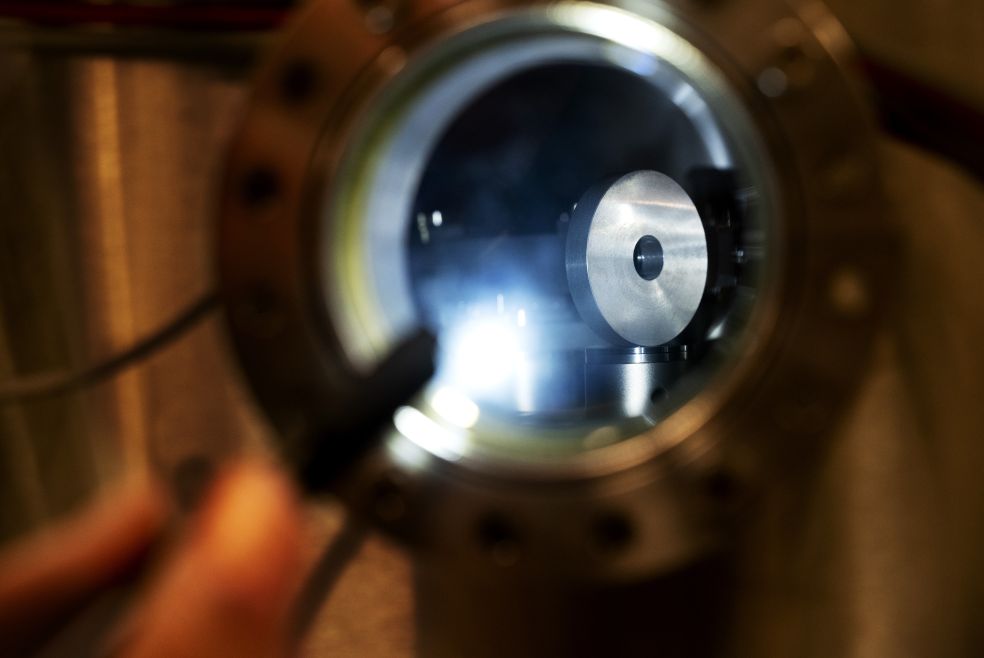
“It is as small a fraction of a second as a second is of the entire age of the universe: 13.8 billion years. These are the timescales on which electrons move, and it is these ultra-fast movements that we are attempting to measure in the project,” he says.
When an electron is released from a molecule, a hole, or vacancy, is created in the electronic structure of the molecule. This creates an imbalance, which nature strives to remedy.
“The system strives for the lowest possible energy state, and the remaining electrons therefore attempt to find a new energy minimum. We want to monitor this charge redistribution in the molecule in real time,” he says.
Creating “chemical tweezers”
Experiments conducted so far in this field have focused on removing the outer electrons of atoms. Feifel and his colleagues are instead concentrating on electrons in the inner shells, i.e., those closest to the atomic nucleus. This offers several advantages.
“Experiments with outer electrons don’t seem to provide the same sensitivity or degree of control over charge redistribution. When we focus on inner electrons, we can create vacancies in the molecular charge distribution in a much more controlled way, enabling us to decide the specific atom in the molecule from which the electron is to be removed. What we are aiming to achieve may be compared to creating highly efficient, laser-driven ‘chemical tweezers’,” he says.
The project involves an in-depth examination of electron dynamics. But although it is basic research, Feifel can already see potential future applications if the project is successful.
“The research could be a step toward being able to control quantum electronic processes. This could make it possible to influence material properties and create new molecules and materials. There may also be applications in molecular electronics, where the hope is to make electronic circuits even more compact than they are today,” he says.
Successful collaboration
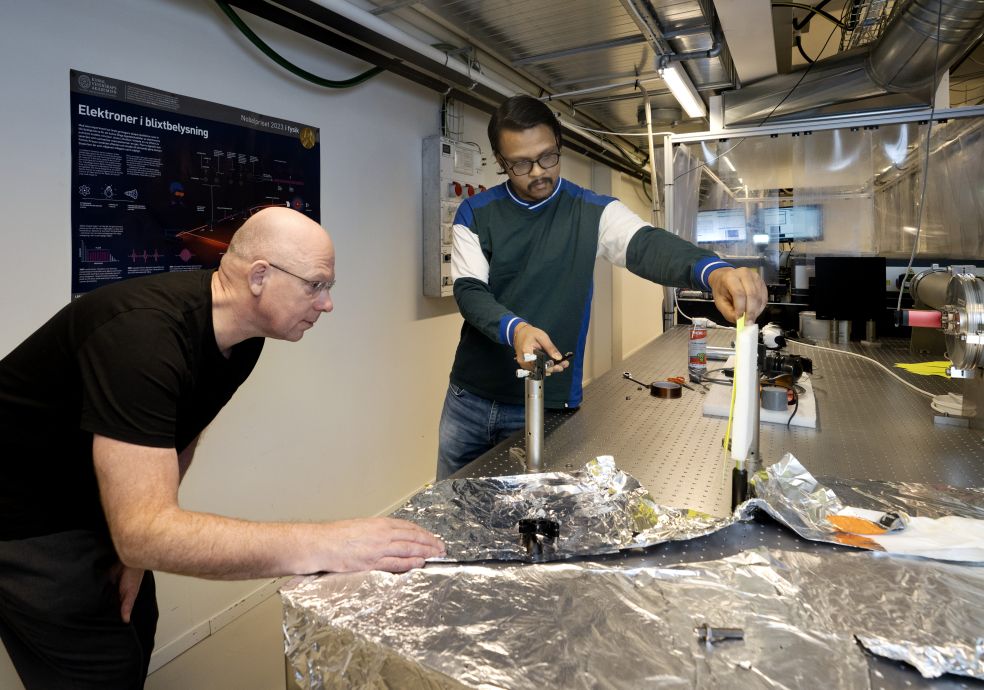
Many of the experiments in the project are taking place in the Attohall at the University of Gothenburg, and also at the Lund Laser Centre and the REAL facility in Umeå. The project grant means the researchers will be able to expand their laboratories with a new experimental station. This will enable them to send multiple isolated laser pulses in rapid succession and to expand the capacity for generating attosecond pulses toward the X-ray photon energy range.
“It’s very gratifying and inspiring to have this opportunity to build such advanced equipment, and it would never have been possible without the grant from Knut and Alice Wallenberg Foundation,” he says.
The project brings together a carefully chosen group from multiple Swedish universities. The researchers contribute a wide range of expertise that combines to pave the way for the project’s success. Participants from Lund and Umeå universities contribute high-tech equipment and perform experiments, while participants from Stockholm and Uppsala universities provide indispensable theory development, modeling and interpretation of the experiments.
“There are not many people in Sweden working in this field, so those of us involved in the project have almost become like a family. We complement each other and collaborate very well. Together we can go much further than if any one of us had worked on the project alone,” he says.
Text: Ulrika Ernström
Translation Maxwell Arding
Photo Johan Wingborg