Mikael Rydén’s discovery that human white adipose tissue has three subtypes of mature fat cells may play a key role in understanding metabolic diseases and guiding the choice of drugs.
Mikael Rydén
Professor of Clinical and Experimental Adipose Tissue Research
Wallenberg Clinical Scholar, extension grant
Institution:
Karolinska Institutet
Research field:
Human adipose tissue, its development and significance for clinical conditions
Research on human adipose tissue and its cells has expanded rapidly in recent years. This is particularly true of the links to insulin sensitivity and the risk of diseases such as type 2 diabetes or cardiovascular disease. The trend has also led to the emergence of modern drugs that can be used to treat obesity and diabetes.
“This development is reflected in a sharp rise in competition in this field. There are much more expertise and much greater breadth than before, which is both exciting and challenging.”
So says Rydén, a professor and Wallenberg Clinical Scholar at Karolinska Institutet (KI) and a senior consultant at Karolinska University Hospital in Huddinge.
Started a fat research laboratory
When he began investigating human white adipose tissue in the late 1990s, his research team consisted of four members. They now number 25, several of whom work in clinical research, cell research and informatics.
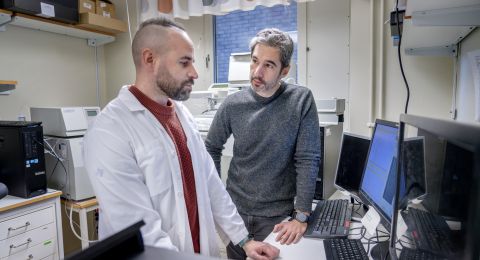
Rydén and his colleague Niklas Mejhert have established a laboratory affiliated to KI and the hospital to study human adipose tissue in a clinical environment and the functions of fat cells at the molecular level. The lab is now one of the largest of its kind in Europe.
“We want to control the entire research process ourselves – from start to finish,” he explains.
Humans carry brown, beige and white fat cells. Rydén is primarily interested in the white ones, which are in fact yellowish. The main function of these cells is to take up and release fat in the body. But they have proven to be more complex than that, and can secrete both hormones and inflammatory markers.
Studies by the researchers at KI have revealed there to be at least three subtypes of mature fat cells in white adipose tissue. Cell and animal models have been used to expose these cells to various stimuli, such as stress hormones and other substances. These experiments have increased the researchers’ understanding of the distinct functions of fat cells.
Their studies have also shown that one of the subtypes can sense the degree of insulin sensitivity, and it also appears to be important for the tissue’s ability to take up and release fat. If that process misfires, metabolic diseases and cardiovascular diseases may eventually arise.
Measuring fat mass
Another subtype senses how much adipose tissue we carry. According to Rydén, this suggests an evolutionary development that has made our bodies strive to maintain a reasonable amount of body fat.
“We mustn’t become too heavy, because then it’s hard for us to move.”
A third subtype is linked to our immune system. These fat cells respond to pro-inflammatory substances and also interact with the body’s white blood cells. He elaborates:
“For example, in patients with inflammatory bowel function, it has been observed that fat cells in the abdomen react and help to modulate or regulate the immune system. This is a very exciting observation that we are examining further.”
We know that the inflammation is caused by a change in the metabolism of fat cells that makes the cell insensitive to insulin but also to other hormones, something we call multi-hormone resistance.
His team is also examining another, new hypothesis.
The researchers believe that the composition of the subtypes themselves – that is, the proportions of each subtype in an individual – is quite unique. This insight is expected to play an important future role in choosing which drug will most benefit an individual with type 2 diabetes or various infections.
“We know that 30 percent of people living with diabetes respond varyingly to diabetes medications. But it’s never the same 30 percent who respond well to all drugs; the proportions differ. We therefore believe that the body’s response may partly be determined by the composition of adipose tissue,” says Rydén.
This question occupies center stage in a study he is heading at the Karolinska University Hospital’s clinic for endocrinology, metabolism and diabetes in Huddinge, involving patients with type 2 diabetes. The researchers perform adipose tissue biopsies and other examinations to observe the distribution of fat cells in each individual. The study currently involves about 60 people, who are randomly assigned to three different drugs for type 2 diabetes.
Low-grade inflammation
Rydén is seeking to reveal the underlying causes of obesity, insulin resistance and type 2 diabetes, all of which are characterized by low-grade inflammation. Despite the low level of inflammation, common anti-inflammatory drugs have no effect on these conditions.
“We know the inflammation is caused by changes in the metabolism of fat cells that make the cell insensitive to insulin as well as other hormones, something we call multi-hormone resistance. This also means that we need to normalize the fat cell in the future.”
Rydén also wants to develop smart biomarkers based on the profiles of the subtypes in terms of the different substances – called adipokines – that they release into the bloodstream. The aim is to interpret how a patient’s adipose tissue is structured.
“As a clinician, it is my dream for the future is to be able to take a few simple blood samples and then tailor the treatment and the lifestyle and exercise advice that best suit the individual patient.
Text Monica Kleja
Translation Maxwell Arding
Photo Magnus Bergström