Floriana Lombardi’s research team is breaking new ground in the quest for room-temperature superconductivity by developing new ways to control the electronic band structure of materials – and thereby how electrons behave within them. In the long term, the research could pave the way for the next generation of ultra-energy-efficient technologies.
Project grant 2024
“Quantum geometry and flat bands towards room temperature superconductivity”
Principal Investigator:
Professor Floriana Lombardi
Chalmers University of Technology
Co-investigators:
Chalmers University of Technology
Ulf Gran
Sergey Kubatkin
University of Gothenburg
Johannes Hofmann
Uppsala University
Annica Black-Schaffer
Grant:
SEK 24,000,000 over five years
Graphene is used as a model system to investigate how these methods work, and the knowledge gained will then be used to control the properties of more complex superconducting materials.
Superconductors can conduct electricity with zero energy loss. They may therefore play a key role in addressing our energy challenges and revolutionize the efficiency of power grids, electronics, and development of quantum technology.
But several technical challenges must be overcome before these materials can be put to practical use. One of the difficulties is that superconducting states often require extreme cooling. In the 1980s, researchers discovered that copper oxide materials become superconducting at much higher temperatures than any previously known material. This made these “high-temperature superconductors” promising candidates in the quest for superconductivity at even higher temperatures.
But there is still a long way to go to the holy grail of superconductivity at room temperature, allowing materials to function in practical applications without cooling and outside the laboratory.
“High-temperature superconductors have unique properties. Yet 40 years after their discovery, we still do not understand the mechanisms allowing superconductivity at higher temperatures. Without that knowledge, we lack the tools needed to design new superconducting materials that function at ever higher temperatures,” says Professor Lombardi, who is based at Chalmers University of Technology.
A smart method of modifying materials
She is leading a project funded by Knut and Alice Wallenberg Foundation that is addressing this challenge. The project team comprises a group of researchers with extensive experience in the field. The aim is to gain a deeper understanding of the mechanisms behind superconductivity at higher temperatures in order to control and model new high-temperature superconducting materials.
Lombardi and her colleagues have already taken important steps toward modifying the properties of these materials. The team recently presented a major breakthrough in the form of a new design principle for the development of high-temperature superconductors. Instead of searching for new materials or manipulating the chemistry of existing ones, the researchers have found a way to remodel the substrate – the supporting surface on which the superconductor rests – and thereby create strong superconductivity that is retained at higher temperatures.
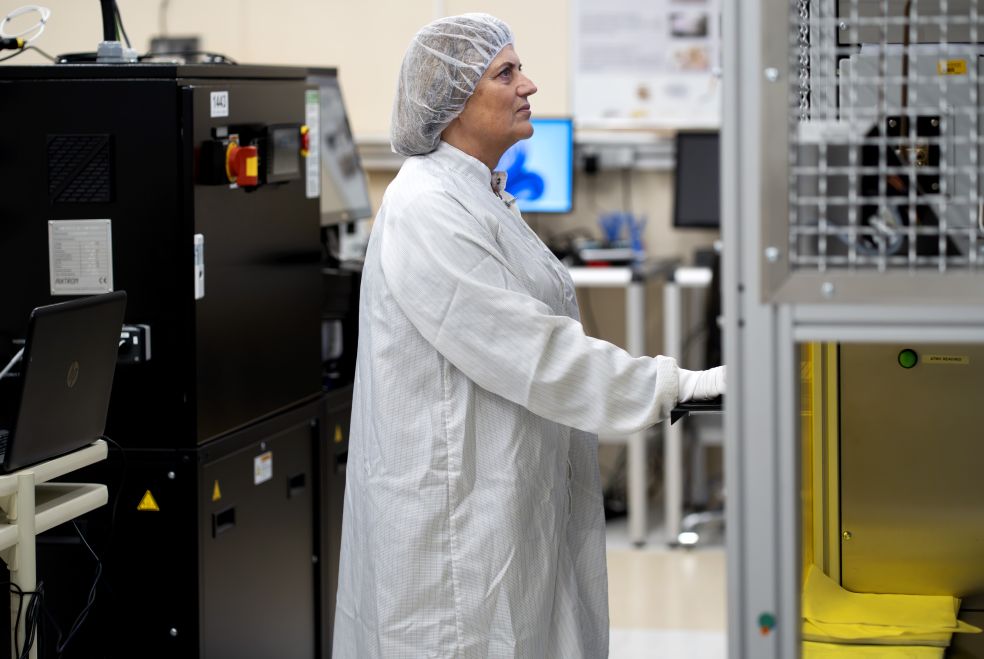
“We have already seen an increase of 20–30 percent in the temperatures at which superconductivity can be induced. Changing the design of the substrate has given us a flexible ‘adjustment knob’ that allows us to modify the properties of the materials and learn more about the processes behind superconductivity,” says Lombardi.
Graphene as a model system
In many high-temperature superconductors, such as copper oxides, strong interactions between electrons are thought to be crucial for superconductivity. Such interactions are generally favored by so-called “flat bands” – a type of energy landscape in which electrons barely move and become heavy, so they influence each other strongly.
The researchers’ new method – modifying the substrate that supports the material – enables them to control the material’s band structure and create flat bands that might enhance superconductivity.
The team has also adopted another new approach in the pursuit of the ultimate goal.
“Strong interactions between electrons may be the key to achieving superconductivity at higher temperatures. But we know such strong interactions make the materials difficult to model. That’s why we’ve added a new ingredient to the project,” says Lombardi.
That new ingredient is bilayer graphene, a material consisting of two atom-thin layers of carbon. The inspiration comes from a widely noted discovery in 2018: when two layers of graphene are twisted by a small “magic angle” relative to each other, the material can become superconducting. At this angle, flat bands form, causing the electrons to interact more strongly with each other.
The research team now wants to create similar conditions without twisting the graphene layers. Instead, they will use electric fields to reshape the electrons’ energy landscape and create flat bands in the material. This gives the researchers a simpler and more controllable system that is also easier to describe theoretically. In this way, they can investigate the role that flat bands play in superconductivity.
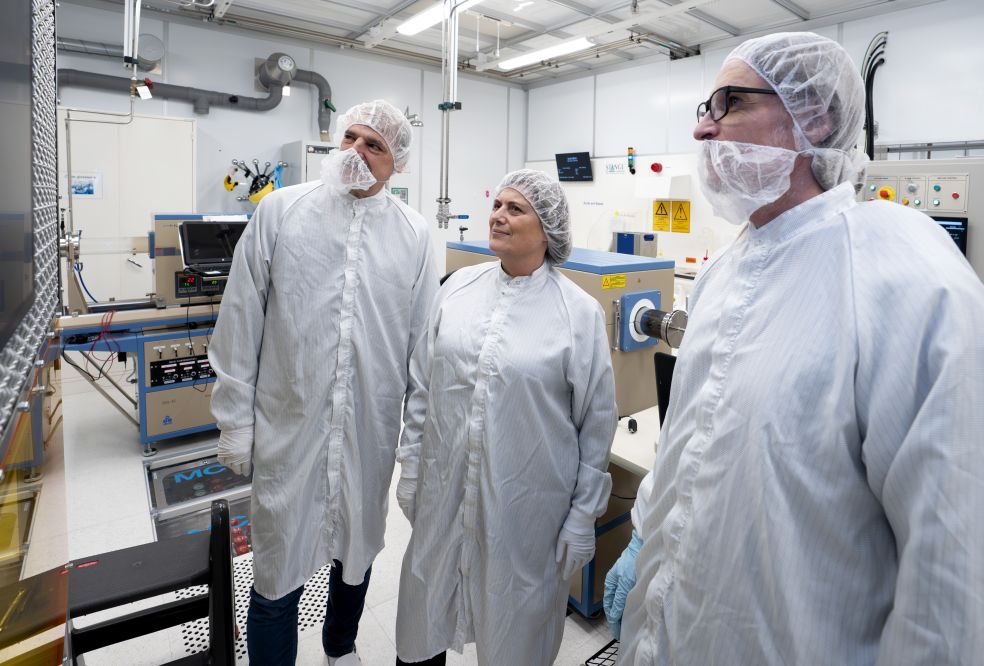
“Copper oxides and bilayer graphene are both layered materials, but the latter consists of only two layers of graphene. This makes the material much easier to understand and work with, while it can still become superconducting,” says Ulf Gran, professor at Chalmers and a member of the project team.
The flat bands in bilayer graphene also have special quantum-geometric properties that the researchers can exploit to make superconductivity more robust.
“Even though the electrons in a flat band are heavy, quantum geometry still allows the material to carry strong supercurrents,” says Johannes Hofmann, University of Gothenburg, who also is a member of the project team.
Major steps toward the ultimate goal
The project includes researchers from Chalmers University of Technology, the University of Gothenburg and Uppsala University. According to Lombardi, it is a unique team whose every participant is crucial to the project’s success.
“We all have different key areas of expertise, both theoretical and experimental. Additionally, Sweden has fantastic research infrastructure in this field, with several laboratories that are absolutely central to our work,” says Lombardi. Nonetheless, she cannot say for sure that the researchers will succeed in every aspect of the project.
“If superconductivity could be achieved at room temperature, it would revolutionize society. We remain realistic about the challenges ahead, but I believe our research can take important steps toward that goal,” she says.
Text Ulrika Ernström
Translation:Maxwell Arding
Photo Johan Wingborg