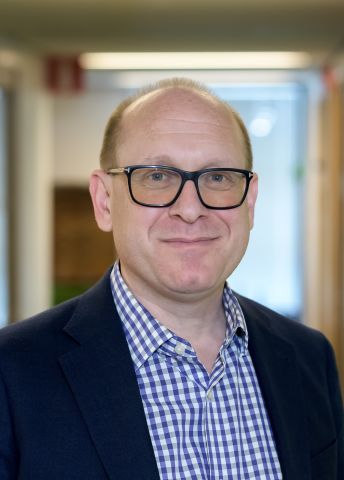
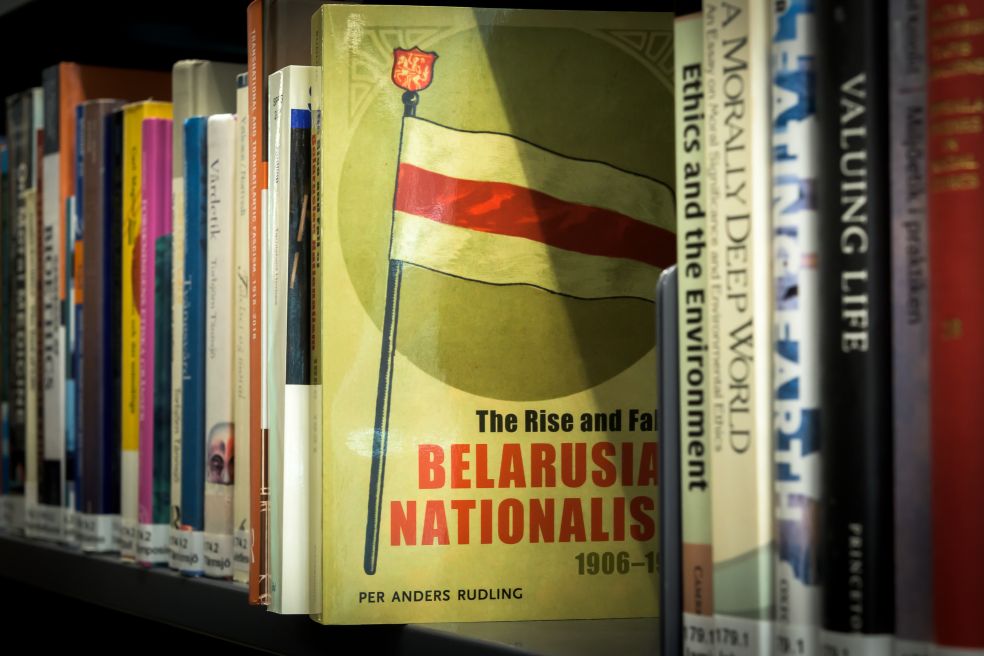
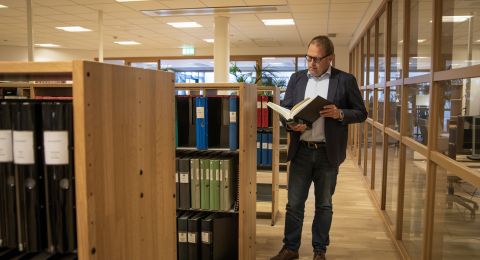
At Lund University, Per Anders Rudling is studying how memory institutions and new European laws politicize history and help to conceal involvement in the crimes of Nazism.
Per Anders Rudling
Associate Professor of History
Wallenberg Academy Fellow, grant extended 2024
Institution:
Lund University
Research field:
Culture of history, nationalism and ideological use of history
Rudling, who is an historian, became a Wallenberg Academy Fellow in 2019. His project then concerned Ukrainian nationalism outside the country’s borders, including Canada, where people of Ukrainian descent celebrated “freedom fighters” from the Second World War without mentioning their abuses of Jews and neighboring peoples.
Three years later, Russia invaded Ukraine, and Russian propaganda called the Ukrainian regime Nazi.
“Suddenly there was a major war in Europe, and precisely these unresolved issues were being used as arguments. It is very much in the interests of democracy for researchers to investigate these issues, but that became very difficult when Ukraine was under such pressure. So, as an extension of the research project, we are now casting the net more widely,” says Rudling.
Nationalism and ideological uses of history in Eastern Europe are being studied in the research environment he is building at Lund University. It is not unusual for young states to highlight old heroes without coming to terms with their involvement in abuses chiefly associated with the Nazis. One example occurred in spring 2026, when Ukrainian President Volodymyr Zelensky named a military unit after the Ukrainian Insurgent Army (UPA), a guerrilla group that fought for an independent Ukraine during the Second World War. Less often discussed in Ukraine is that the UPA, together with German soldiers, was involved in the ethnic cleansing of Poles and also massacred civilians. Zelensky’s naming of the unit and his refusal to back down sparked a diplomatic crisis between Ukraine and Poland.
“These are difficult questions that still need to be addressed by several young states in Eastern Europe. They are of practical and political importance, and I hope that our research team in Lund can provide a platform for discussion. Research in this field may be easier for us in Sweden, due to a somewhat greater distance, than for German historians, for example, or critical researchers in the states concerned.”
No monopoly on history
Rudling is also studying more recent trends in memory culture, where history meets politics. He emphasizes the role of the “memory institutions” established in countries such as Ukraine, Poland and Lithuania, with the aim of highlighting national history – often selectively. Several countries have enacted or are planning memory laws stipulating that an event or period must be described in a particular way.
“People talk about a country having a ‘right to its history.’ But history does not work as a tool to enable a state or group to acquire a monopoly on the ‘correct’ way of describing it,” says Rudling.
There are also laws prohibiting denial of certain historical events, the Holocaust being one example. Naturally, the underlying motive need not be nationalism; laws in several Western European states have instead been motivated by concern about radical nationalism itself. But problems arise when the laws also concern genocides that are defined differently among historians and politicians. There are examples of this.
History laws are imposing growing constraints on what can be said. This is a problem throughout much of Europe.
“Legislation introduced in Sweden in 2024 following pressure from the EU also criminalizes denial of other genocides, although it is somewhat unclear which ones. Politicians decide what happened instead of allowing researchers to assess it. Alongside authoritarian currents, we are therefore seeing a more politicized history. Our research is intended to shed light on this.”
Rudling’s team is studying historical sources as well as social media and other channels in order to analyze how history is described and how politicians use it to pursue ideological projects. Linguistic breadth is central.
“A considerable part of Holocaust research is carried out by scholars who know German but not local languages of the land where it took place; Polish, Ukrainian or Yiddish. The result is often a somewhat German-centered history in which the motives, role and responsibility of local actors disappear. The researchers in our team know Lithuanian, Ukrainian, Hungarian, Romanian, Russian, Belarusian, Polish, Yiddish, Hebrew and German.”
Trying to keep a distance
Rudling's interest in Russia and Eastern Europe began during his high school years, when he studied Russian. He went on to study Slavic languages, East European studies, and political science before earning his doctorate in Canada. He has also conducted research and taught in Germany, Norway, Austria, Singapore, and at Södertorn University in Sweden.
“When I received my master’s degree in Uppsala in 1998, you were practically unemployable as a specialist in Slavic languages in Sweden. After 2001, Arabic was what was needed, or Dari or Farsi. But after 2014, we were needed again. I don’t think we’ve ever had as much media exposure at the Department of History in Lund as we have now.”
The number of inquiries from the media and politicians, combined with the need to provide help and support to Ukrainian researchers who have fled to Sweden, has placed added pressure on Rudling and his colleagues.
“History is my field, after all; I like to have at least one generation or one language between myself and what I study. But I was mistaken in thinking I could maintain a distance by studying a period before my own birth and a country of which I am not a citizen. Now there is a war and somehow you get drawn into it.”
Text Lisa Kirsebom
Translation Maxwell Arding
Photo Kennet Ruona