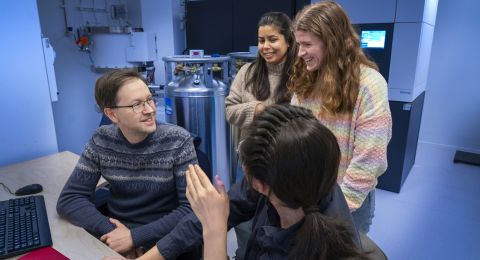
It is now possible to treat the inflammation that causes rheumatoid arthritis, but the pain may persist nonetheless, and become chronic. Patrik Ernfors is heading a project that aims to trace the origin of the pain. These advances may ultimately lead to entirely new therapeutics.
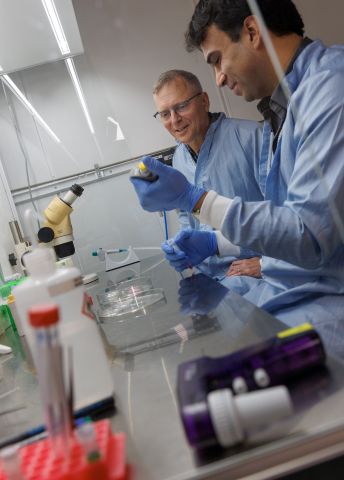
Project grant 2024
New chronic pain mechanisms: Spatiotemporal dynamics of dysregulated proteins in inflammatory pain
Principal investigator:
Professor Patrik Ernfors
Co-investigators:
Karolinska Institutet
Onur Dagliyan
Linköping University
Saad Nagi
Håkan Olausson
Grant:
SEK 34 million over five years
Opioids are often used as an important medication to alleviate chronic pain. People have relied on the pain-relieving properties of the opium poppy since time immemorial. Morphometric analyses reveal that the plant has been cultivated in Europe for at least 5,000 years. There is now a pressing need to replace opioids, however, both because of side-effects such as addiction, and due to their widespread use outside healthcare.
“One of the reasons we don’t have better painkillers is that pain mechanisms are so hard to understand. But for chronic arthritic pain, we have made progress we hope will lead to a better understanding,” says Ernfors, professor of tissue biology at Karolinska Institutet.
Rheumatoid arthritis can now be treated successfully, but in a quarter of patients the pain may persist for life. Ernfors’ research team has identified a signaling pathway that may play a central role in the onset of joint pain.
“We have identified a type of neuron and a signaling pathway that may cause the pain. What is interesting is that the mechanism is separate from the inflammatory process.”
Controlling proteins with light
Rheumatoid arthritis causes a dull, aching pain. This is due to hypersensitivity in the fibers of pain-sensing neurons (nociceptors). The pain can be caused either by activity, such as shaking someone’s hand, or by spontaneous activity in the neurons.
“We want to try to understand what makes them so sensitive. We’ve already demonstrated a signaling pathway in animal models. Now we want to examine it in humans.”
To succeed, the researchers are using several highly advanced methods. In previous research, Ernfors’ team identified a specific protein as a possible cause of pain. But they do not know yet whether that protein alone can control the mechanisms in the cells that cause pain. One step toward a better understanding involves a technique called optogenetics.
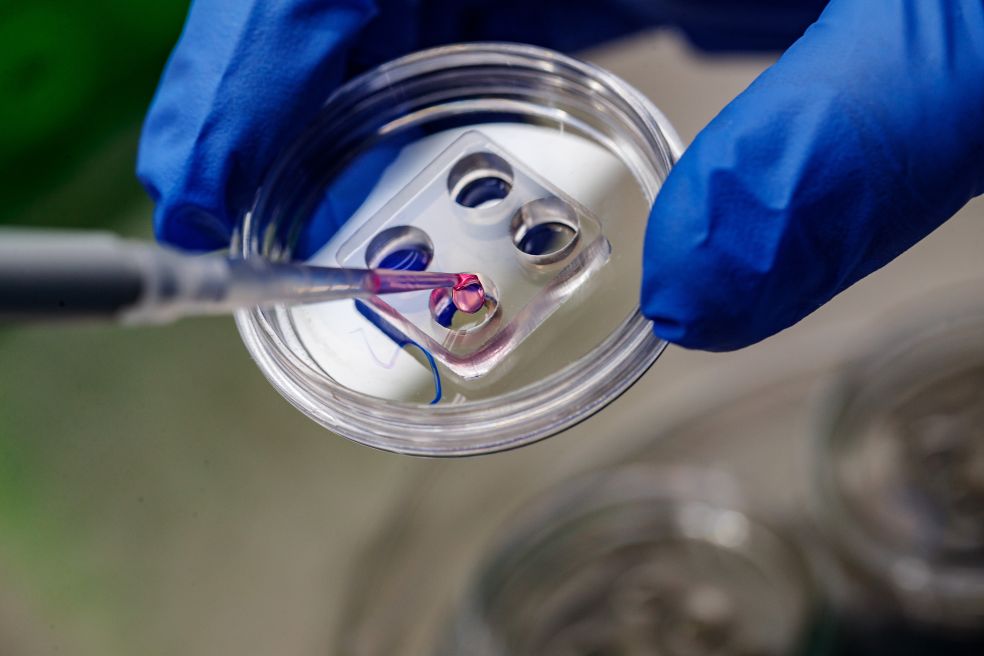
This technique enables researchers to influence the function of neurons using light. Optogenetics was developed at Stanford University in the U.S. in the early 2000s and was quickly adopted in Sweden.
“Previously, optogenetics has been used to control the activity of neurons. Now we are moving on to control proteins with light. My colleague Onur Dagliyan is responsible for this part of the project. It actually sounded like science fiction the first time I heard about it,” says Ernfors.
Achieving this goal entails creating a modified version of the pain-related protein that can be controlled using light. Simply put, the protein is genetically modified to respond to light at certain wavelengths. When researchers shine light of a specific wavelength on the skin, the protein responds by changing shape. This structural change activates it in the cell. If this leads to pain, it means the protein influences the pain mechanism in the cells.
Confirmed in humans
The next step is to confirm the results in the human body. This work involves Håkan Olausson, physician and professor of clinical neurophysiology at Linköping University and a Wallenberg Clinical Scholar. He is one of the few people in Sweden who can measure signals in individual nerve fibers. The technique is called microneurography and involves placing a thin needle into a single nerve fiber to measure the signals passing through it.
These measurements can show objectively whether nerve activity and the experience of pain are affected by the mechanism that the researchers have discovered in animal models. If it turns out that blocking the protein helps, this will open the way to developing new drugs for patients suffering from chronic pain.
“The goal of our project is to understand the mechanism itself, after which others can use our findings to develop new drugs. One in five adults today suffers from chronic pain, so there is an urgent need for more therapies.”
No one knows whether blocking the protein alone is enough to stop the pain. The researchers therefore also intend to demonstrate exactly how the protein in question affects cellular function.
Investigating all proteins
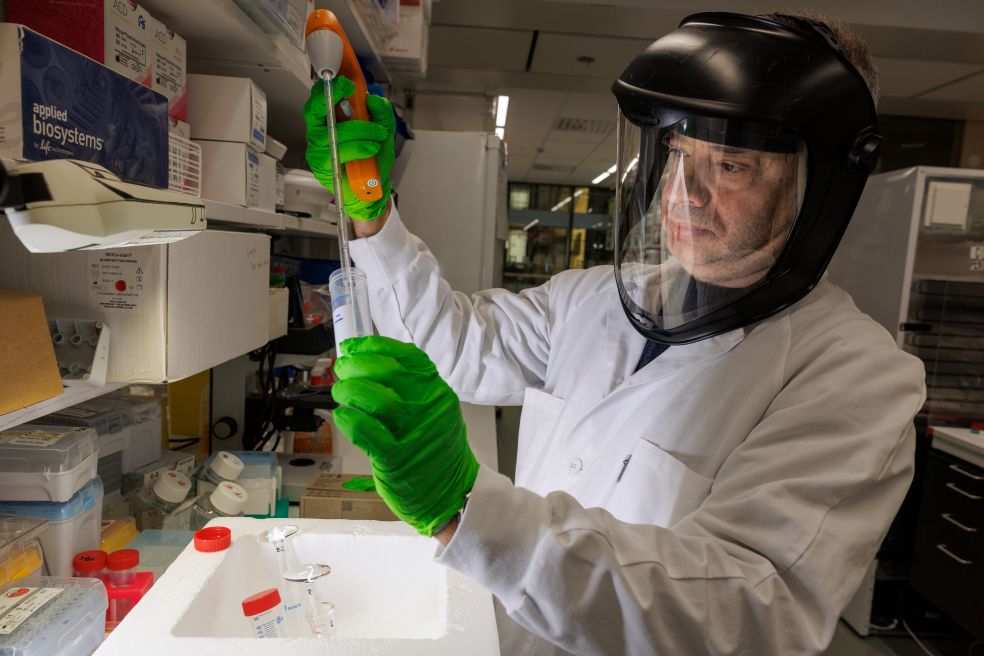
To understand the function of the protein in the cell, the researchers are using large-scale methods capable of mapping all proteins in the cell. This field is called proteomics and can provide in-depth information about changes in the cell under different forms of influence.
The project is very much technology-driven and combines expertise in areas including protein engineering, optogenetics, preclinical pain research and microneurography. The use of large-scale methods generates enormous and complex datasets, making the research highly dependent on expertise in computational biology.
“We constantly strive to keep abreast of the latest technological advances, since they facilitate much of our research. New technology continually adds to our understanding of human biology and the processes involved in disease,” says Ernfors.
Text Magnus Trogen Pahlén
Translation Maxwell Arding
Photo Magnus Bergström