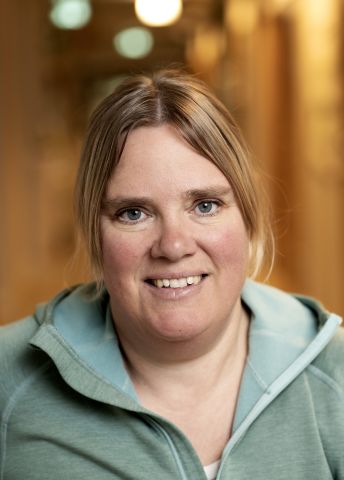
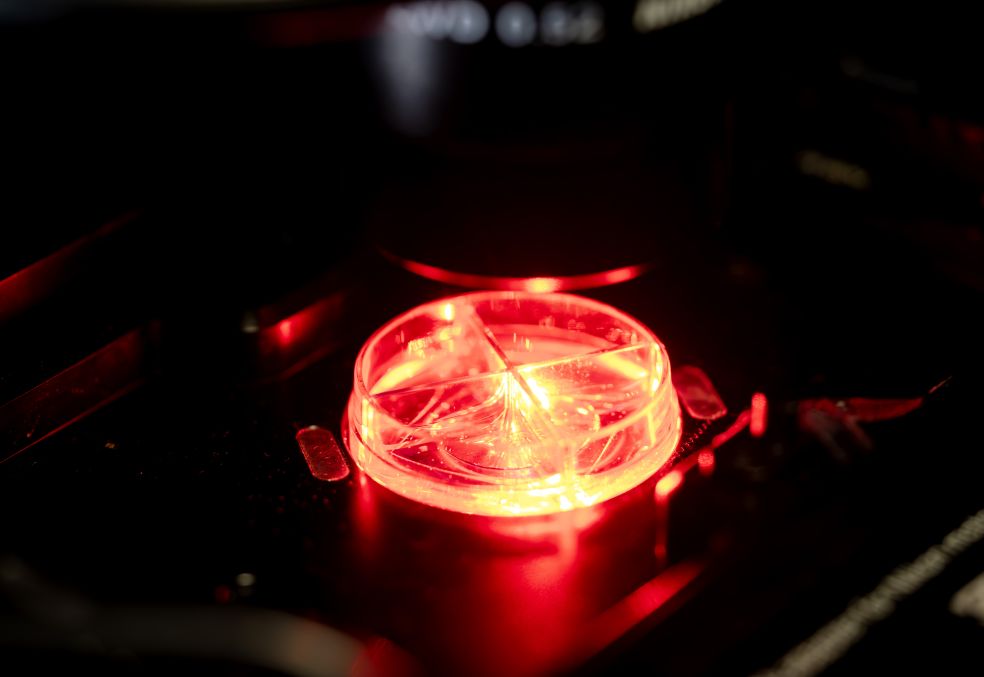
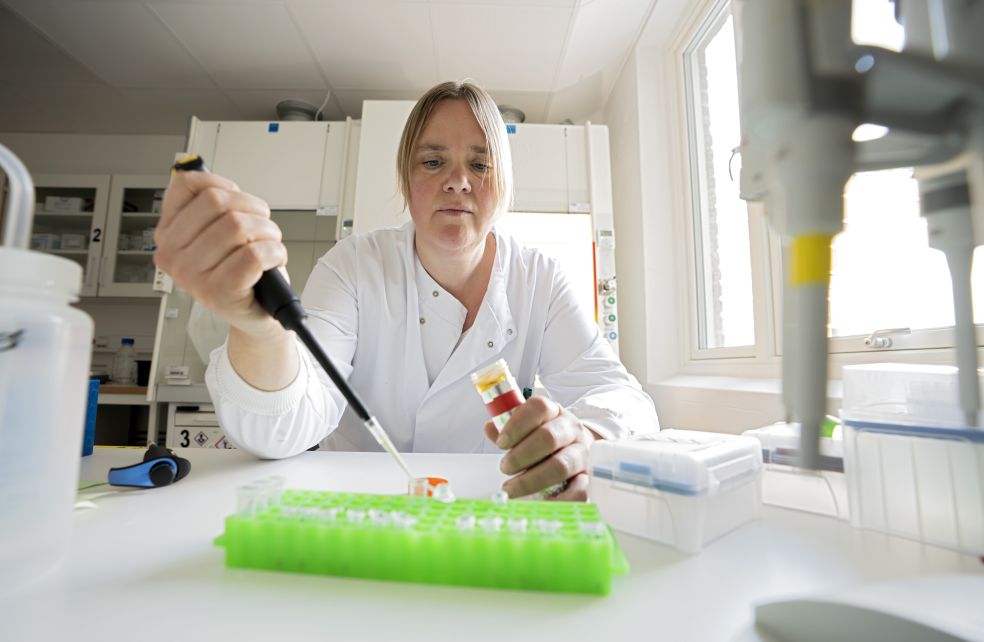
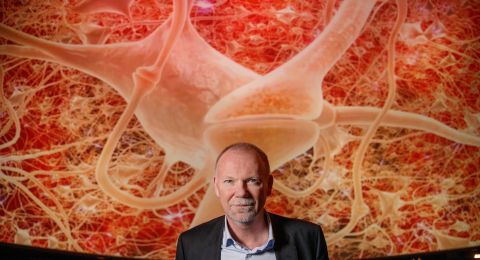
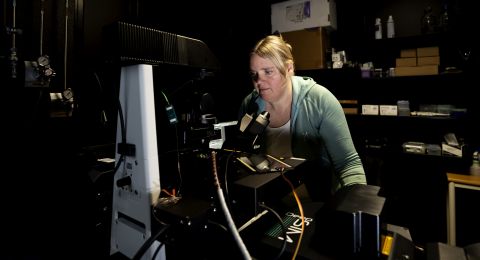
Elin Esbjörner is searching for important clues to aid our understanding of some of the brain’s most challenging diseases, such as Parkinson’s and Alzheimer’s. To this end, she will map the cells’ transport and sorting system: the endosomes. Her research, which has already seen significant breakthroughs, could open up new avenues in the search for effective drugs.
Elin Esbjörner
Associate Professor of Chemical Biology
Wallenberg Academy Fellow, extension grant 2024
Higher education institution:
Chalmers University of Technology
Research field:
Protein aggregation mechanisms and amyloid formation in neurodegenerative diseases
Esbjörner, who is a Wallenberg Academy Fellow, focuses on neurodegenerative diseases, in which neurons in the brain and central nervous system are gradually broken down and die. Alzheimer’s and Parkinson’s are two of the most common diseases of this kind, affecting tens of millions of people around the world.
A typical feature of these diseases is the formation in the brain of clumps of misfolded proteins, known as plaques or protein aggregates. These make it increasingly difficult for neurons to communicate with each other. These protein aggregates caught Esbjörner’s attention many years ago and led her into this field of research.
“I was utterly fascinated when I saw them for the first time. Protein aggregates have long, spiral-shaped threads that are intertwined, and are actually quite beautiful. That awoke my curiosity and desire to understand these structures, and I still find protein aggregates incredibly fascinating,” she says.
Key processes little understood
Why the clumps form and how they cause damage are among the fundamental questions that Esbjörner and her team are seeking to answer. She is particularly interested in the processes taking place inside and between neurons when protein aggregates are taken up and transported from one cell to another.
“It’s clear that these spreading processes play a major part in the development of these diseases. In patients with Parkinson’s, for instance, aggregation begins in a specific area of the brain and then spreads in a predictable pattern. But although we can see that this happens, we know far too little about the underlying mechanisms,” she says.
Global research into Alzheimer’s has made great strides in recent years. Drugs that slow the disease are now approved. Treatments work by reducing the quantity of protein aggregates in the brain. Esbjörner hopes her research will contribute further pieces to the puzzle.
“If we can find ways to understand and combat the spread of protein aggregates, we may be able to make current drugs even more effective. Achieving this will require particular focus on the endosomes, i.e., the cells’ transport and sorting stations,” she explains.
Small vesicles that could provide big answers
Endosomes are small, membrane-bound vesicles that process much of what cells take in. They redistribute and transport substances to the right place, and ensure that waste and debris are dispatched for breakdown and recycling. If this key function misfires, many things can go wrong in the body. Previous research has established a connection between endosomes and protein aggregates.
There are many knots to untangle, but perhaps that’s why I find this field of research both interesting and incredibly meaningful.
“We know, for example, that some protein aggregates can make tiny holes in endosomes, but we don’t know how or why. An in-depth understanding of these mechanisms is vital in order to develop the drugs of the future, and gaining that understanding is therefore one of our key goals.
The group has already made significant progress in understanding how endosomes interact with protein aggregates. One major breakthrough was the discovery that some, but not all, protein aggregates bind to the surface of endosome membranes. The researchers’ investigation showed that only newly formed endosomes are involved in this interaction, giving their subsequent research a clear direction.
“We now know that we need to focus on what happens in early endosomes, because that’s where binding to the protein aggregates occurs. The next step is to ascertain exactly what happens and show how these interactions cause the endosomes to change or be destroyed – and then to find ways to counteract these processes,” she says.
Welcomes surprises
Esbjörner hopes that research into the processes that destroy endosomes will help improve treatments for both Alzheimer’s and Parkinson’s. But many challenges lie ahead.
“What should the medicines bind to? How do we get them there? And what should we stop? Should we try to dissolve the aggregates or prevent them from spreading? There are many knots to untangle, but perhaps that’s why I find this field of research both interesting and incredibly meaningful. I think most people know someone who has suffered from one of these diseases, which, until now, we haven’t been able to do much about,” she says.
She says that receiving an extended grant as a Wallenberg Academy Fellow has given her a great sense of security, and plays a vital part in enabling her to carry out the long-term basic research on which she focuses.
Curiosity and the prospect of discovering something unexpected are among the drivers for her research.
“I enjoy my work most when I am surprised and things turn out completely differently from what I had expected. It spurs me on to find out more about what I haven’t understood, which I find incredibly exciting,” she says.
Text Ulrika Ernström
Translation Maxwell Arding
Photo Johan Wingborg