Imagine a material with fantastic conductivity that is also stretchable, soft, and possesses excellent mechanical properties – one that can be woven into clothing or attached to the skin. This is on its way to becoming reality, and Wallenberg Scholar Professor Christian Müller is taking important steps toward it.
Christian Müller
Professor of Polymer Technology
Wallenberg Scholar 2024
Institution:
Chalmers University of Technology
Research field:
Polymer technology and organic electronics
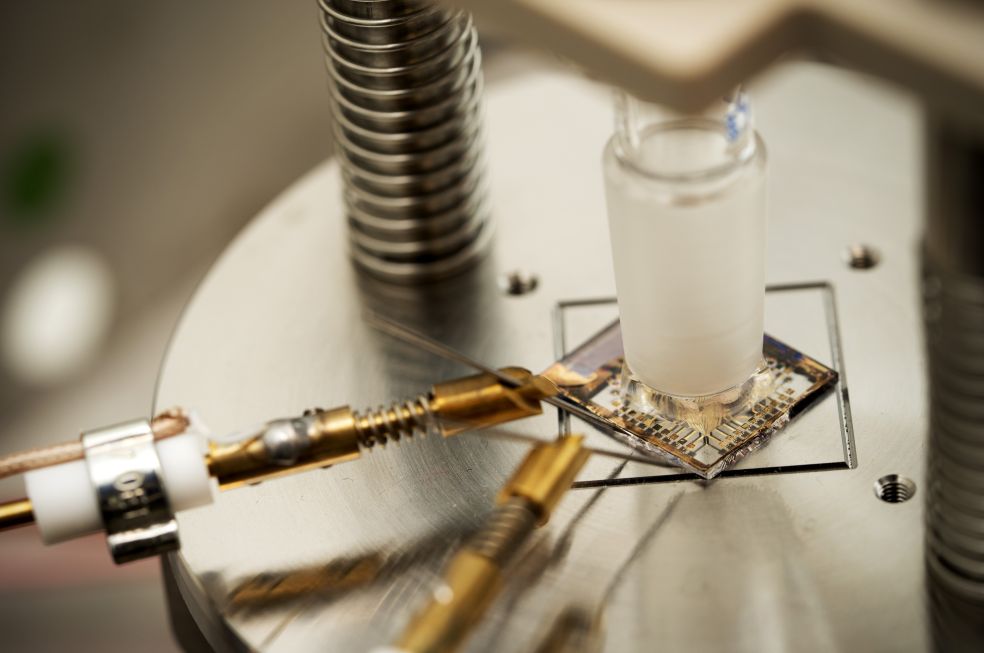
At present, silicon is the primary semiconductor material used in the majority of our technology. But if we can instead use organic, carbon-based semiconductor materials – known as conductive polymers – it will be possible to create conductive materials with entirely different properties.
Polymers can be described as plastic materials with long chains of carbon molecules, which helps when making stretchable and flexible materials. Research on these highly sought-after materials is under way all over the world, as they offer potential for everything from energy storage to bioelectronics – creating new opportunities in medical diagnostics and rehabilitation, for example.
This has been Müller’s field of research for more than twenty years. In his new project, he is focusing particularly on how polymers can pave the way for elastic biotechnological components such as sensors or wearable devices. The prospects are good because these are organic materials that function well in contact with the body – and that the body functions well with.
“Unlike silicon-based materials, conductive polymers can convey an electrical charge via both ions and electrons, just as our own bodies do. This enables us to connect biology and electronics, and to create electronic components that can be integrated very effectively with various biological systems,” he says.
Imitating the mechanics of our bodies
Müller’s research team has already made important advances in this field. Among other things, they have developed a new method of manufacturing the materials on a larger scale, without toxic chemicals, and in a more cost-effective way.
Over the next few years, the focus will be on further improving the materials to give them optimal electrical and mechanical properties.
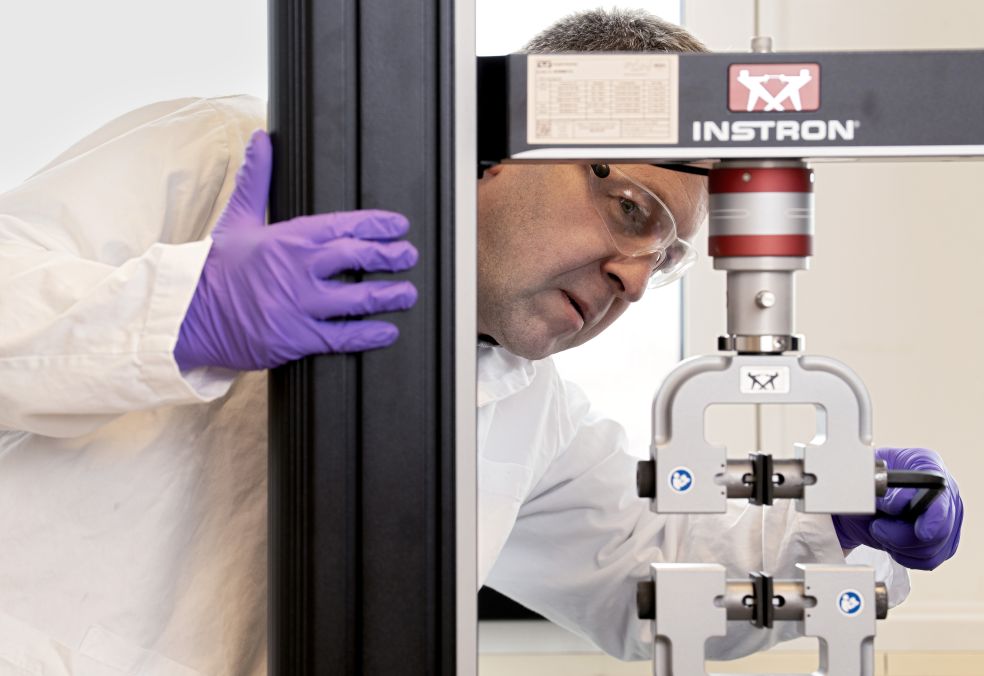
“Current organic semiconductor materials are still a little too stiff and hard. We want the mechanical properties to resemble the mechanics of our bodies as closely as possible. We therefore need to create materials that are highly stretchable, lightweight, elastic and adaptable, and that have the same softness as our skin or tissues,” he says.
Müller likens the material the researchers want to create to a suit of chain mail. Although the small metal links in the chain mail are robust and stable, they have been joined together in a way that creates flexibility and suppleness in the garment.
“We are investigating how we can create a similar structure for conductive polymers at the molecular level,” he says.
Conductive textiles benefiting healthcare
But it is no easy task to create materials with good electrical conductivity that are also soft enough to have favorable mechanical properties. One major difficulty is that a material’s conductivity is often linked to its rigidity: the softer a material is, the worse it conducts electricity.
It’s a wonderful feeling to realize that something you have worked very hard on will actually function.
“To achieve our goal, we need to combine different classes of materials and work with composites – materials consisting of several components. One part may conduct electricity; another is soft and has binding properties. In this way, we can move closer to materials in which electronics and mechanics are optimally connected,” he says.
Although Müller’s work is purely scientific, he can clearly see several potential applications for the field. The stretchable and flexible nature of the materials means they can be used to create fibers and yarns that can be woven into ordinary fabrics – offering enormous potential in the healthcare field.
“If bioelectronic sensors can be integrated into our clothes or placed on our skin, they can interact smoothly with our bodies to analyze our health. Sensors of this kind could measure heartbeat, pulse and breathing, or monitor important bodily functions in elderly care patients or in patients who have been discharged from hospital,” he says.
Wanting to understand – and discover something new
Müller has always wanted to understand nature. When he was young, his classmates said he would probably become a professor one day, but he himself had no clear picture of the future.
“I never had a clear ‘master plan’ about what I wanted to do and where I wanted to go. I still do not always have one, even today. But during my school years I had many fantastic teachers who encouraged me. My physics teacher gave me the key to the laboratory so I could go there after school hours, and I remember that my chemistry teacher created an extra exam to set me a greater challenge. That has meant a great deal to me, and I try to create similar opportunities for my own students,” he says.
When describing his motivation, he draws a parallel with his children’s experiences when they explore the world.
“The joy they feel when they discover something for the very first time is wonderful to behold. It’s a fantastic feeling to realize that something you have worked very hard on will actually function. If I never lose the joy of finding something new after a long working life, then I will be very grateful,” he says.
Text Ulrika Ernström
Translation Maxwell Arding
Photo:Johan Wingborg